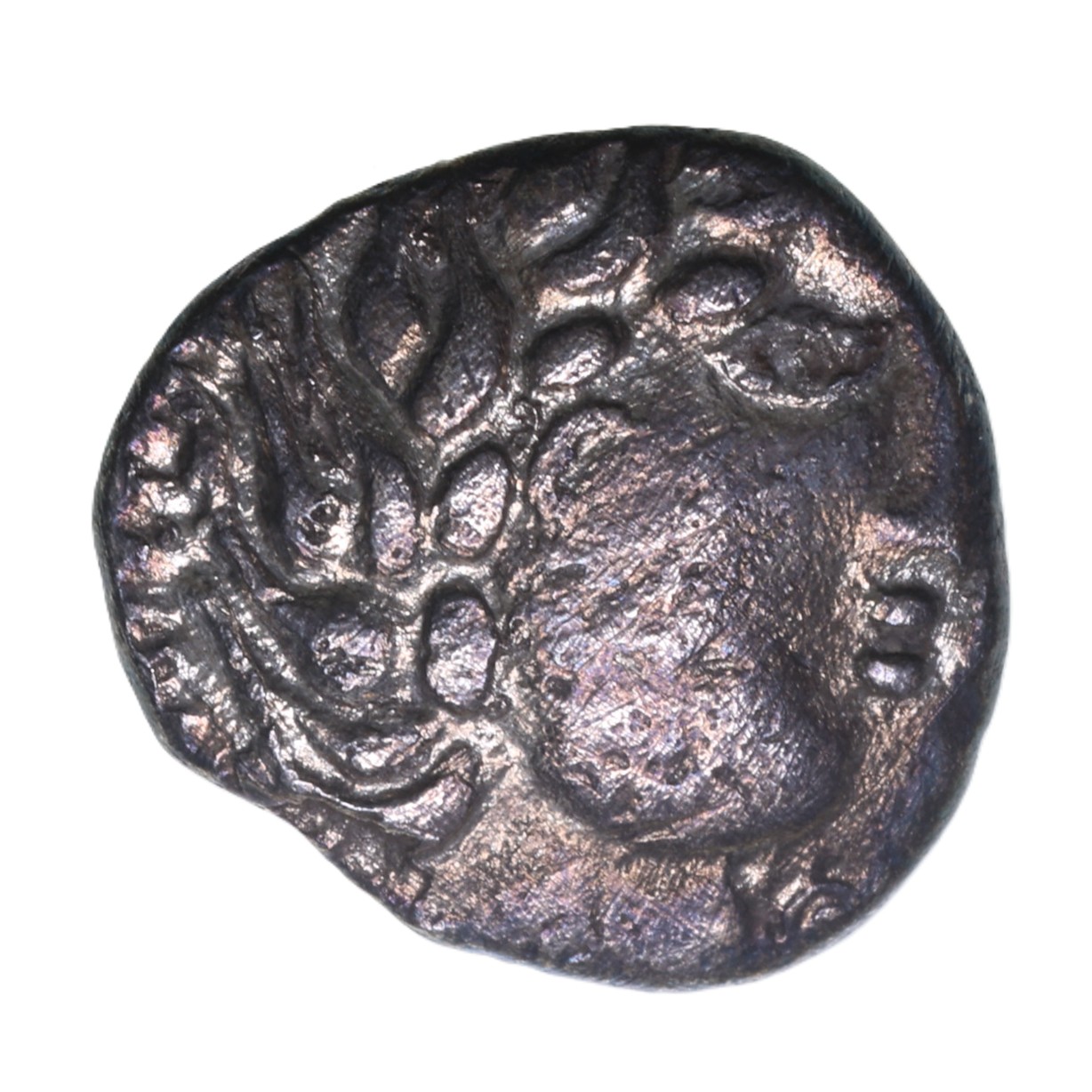
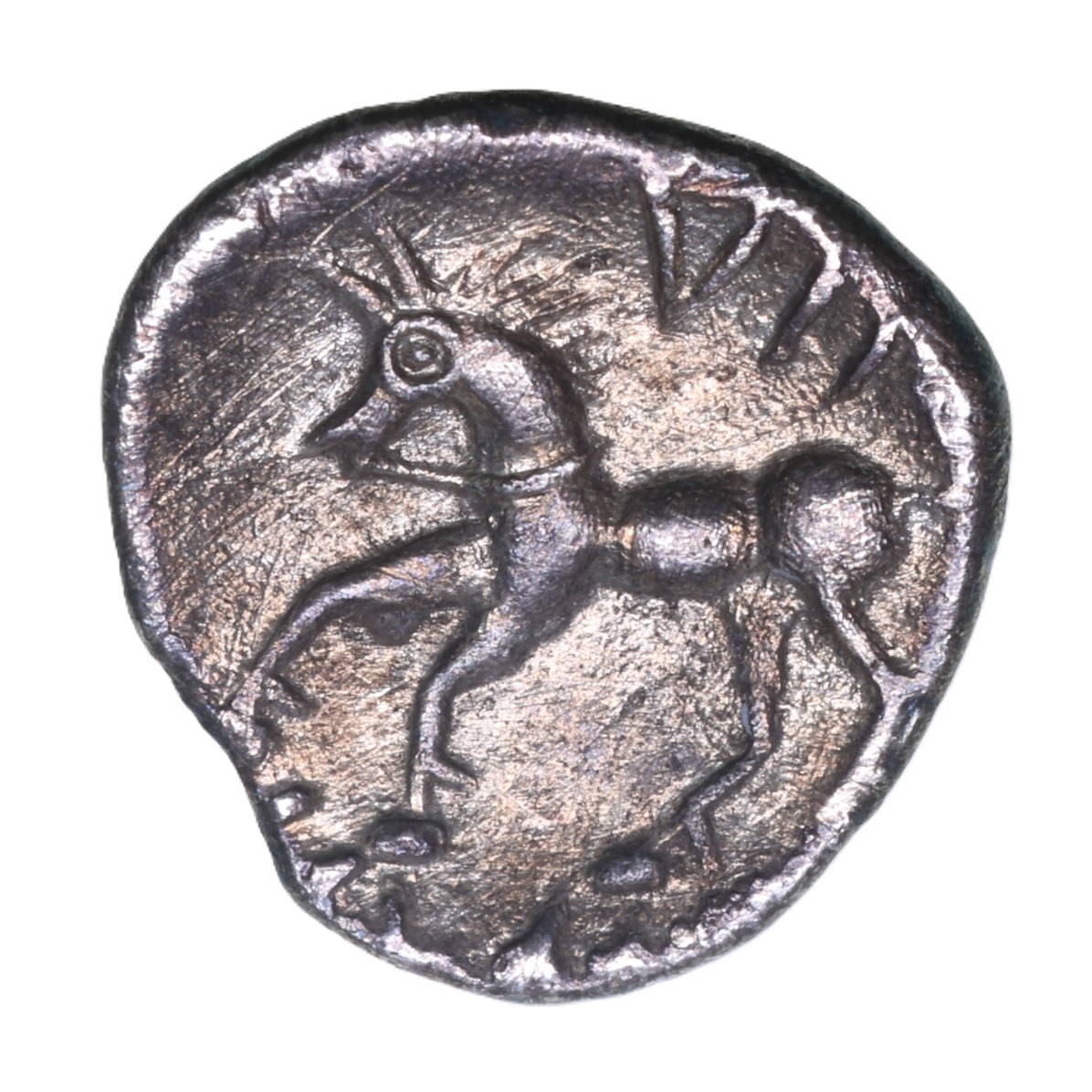
Catuvellauni Tasciovanos c. 25 BC-AD 10 Berkshire Wreath Silver Unit *Excessively Rare*
£875.00
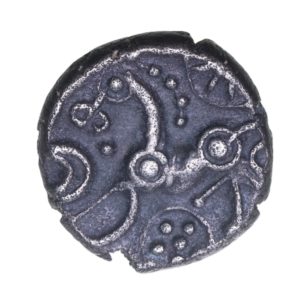
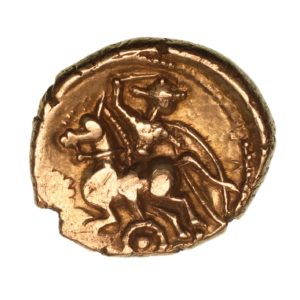
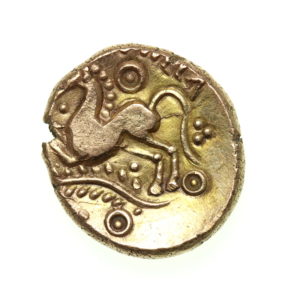
Catuvellauni Tasciovanos c. 25 BC-AD 10 Berkshire Wreath Silver Unit
Excessively Rare, 8 known.
ABC 2616, 12mm, 1.02g
Obverse
Crude laureate head right, oval eye with pellet, small crescent ear. TAS inscription (outward-facing) in front.
Reverse
Horse stepping left. VIR inscription above.
Mint
| VIR | Verlamion, modern-day St Albans, United Kingdom (circa 20 BC – AD 43) |
Comments
Despite the inscriptions that place this coin with the Catuvellauni in Hertfordshire (Tasciovanos ruled from Verlamion, and both are apparently mentioned), the findspots are very firmly in Berkshire, the territory of the Atrebates. As well as VIR above the horse, some examples appear to have CO before the horse.
Known findspots: Berkshire (Compton, Welford, Chieveley, Winterbourne, Hermitage, Cox Green), Oxfordshire (South Oxfordshire), Kent.
Provenance
This coin is from The London Collection of Ancient British Coins. For more information click here: The London Collection – Silbury Coins : Silbury Coins.
C Rudd FPL 154, no 36 (2017).
This coin comes with a previous label.
Tasciovanos (c. 25 BC–AD 10)
Following on from Addedomaros, who may or may not have been his father, we find Tasciovanos – whose coinage is some of the most complex and extensive within the North Thames series. An apparently long-lived ruler, traditional narratives of the Late Iron Age cast him as a dynamic and decisive individual who laid the groundwork for the success of his own son, Cunobelin, by extending Catavellaunian influence eastwards into East Anglia and Kent. While his coins generally take influence from indigenous art styles, some ‘classification’ is visible (though to a relatively limited degree) on specific types within his issues of silver and bronze. Some of the most impressive North Thames issues are exemplified by his gold staters, such as the ‘Tasciovanos hidden faces’ and ‘Tasciovanos warrior’ types (ABC 2553/BMC 1591–1603/ABC 2571/BMC 1615–16), both of which employ highly stylised, geometric motifs on their obverse faces. This medium also can be found on numerous examples of his bronze coinage, such as on the highly enigmatic ‘Tasciovanos Verlamio’ type. Here, the obverse depicts an eight-pointed star with the mint-name (VERLAMIO) cleverly interspersed between the points.
1 in stock