
Eastern 1st Century BC Tring Wheel Southern Style Gold Quarter Stater *Excessively Rare*
£2,750.00
Eastern 1st Century BC Tring Wheel Southern Style Gold Quarter Stater
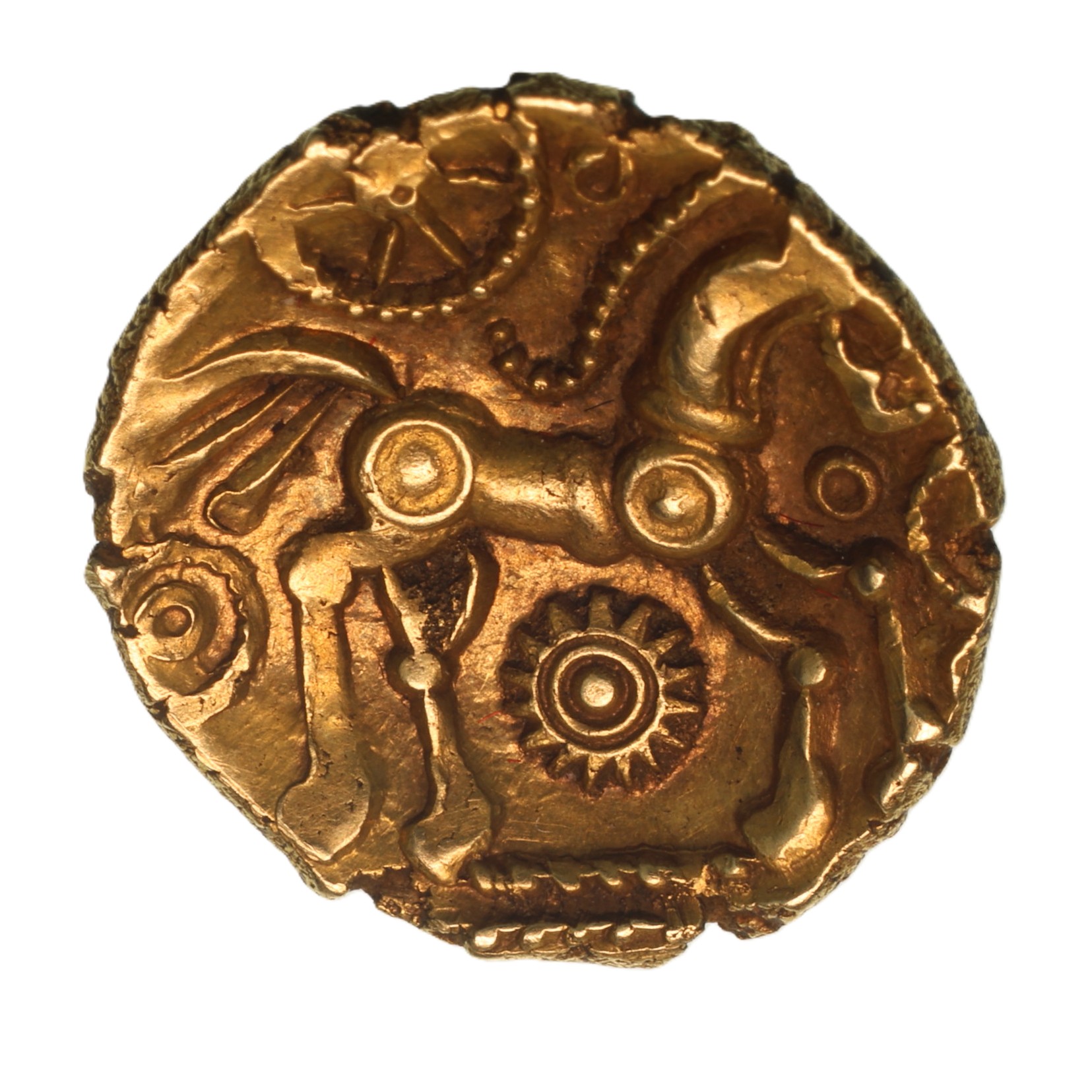
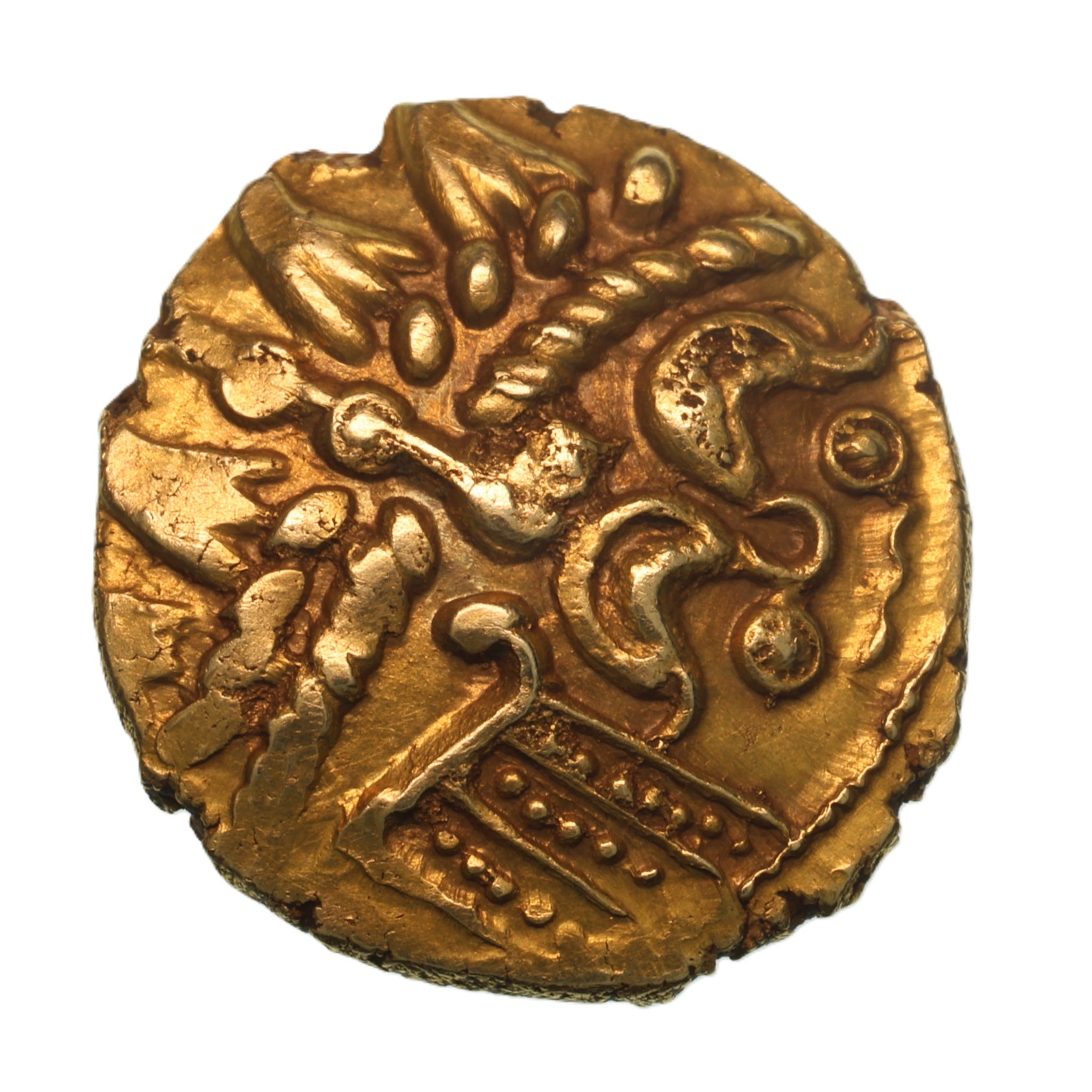
Abstracted head of Apollo right (with inside end of each leaf pointing downwards above the hairbar, and upwards below the hairbar, the upper and lower parts at an angle to each other). Hairbar (spike) is decorated with three pellet-in-ring motifs with a small annulet above the twin arcs (hooks) at the end. Zigzags in the hair curls, below the cloak and in front of the face. Cloak has rows of pellets between lines.
Triple-tailed annulate horse right with fine, rolled up pellet mane and rings at both ends. Wheel with pellet rim above with five to seven spokes. Cogged sun (cog) below. Pellet in beaded circle in front and behind.
Excessively Rare
A crisp, central strike on both sides, high grade
ABC 2228; 13mm, 1.29g
11 known.
Allen Type: British Qc (Remic type).
Sills Tring Wheel (8 obverse, 7 reverse dies): Early North-West Thames Coinage; Type: Indeterminate and Local Issues; Quarter Staters: Tring Wheel. The obverse is a direct copy of British Qc quarters (ABC 500) and almost identical. The reverse is from Qc Wheel and Cog (ABC 509), although the horse is annulate at both ends.
Sills DK 476/477
Sills chronology: Gallo-Belgic Ca – British G (Early Clacton) / Aa Westerham – British La (Whaddon Chase) – British Lb (Westbury) – Local Issues.
Provenance
This coin is from The London Collection of Ancient British Coins. For more information click here: The London Collection – Silbury Coins : Silbury Coins
DNW auction 97, lot 55 Dec 2011. Matthew Rich collection. CCI 00.1993
This coin comes with a previous label.
Eastern
There are 33 early uninscribed types, found mainly in the eastern part of the North Thames region, especially Essex, which can’t comfortably be attributed either to the Trinovantes of the Catuvellauni. They are mostly extremely rare types – only seven were published by Van Arsdell, and they don’t seem to slot into any of the principle North Thames series. These may be variants struck by the Trinovantes or Catuvellauni or they could have been struck by smaller sub-tribes.
Out of stock
You may also be interested in these…
Related products
-
Catuvellauni & Trinovantes Cunobelin Plastic Type Gold Quarter Stater 8-41AD
£425.00Code: JC517
-
Trinovantes, Duck Helmet Silver Unit 60-20BC ext. rare
£1,450.00Code: JC735
-
Catuvellauni & Trinovantes Cunobelin Gold Quarter Stater Classic Type 8-41AD
£395.00Code: AC295
-
Trinovantes Gold Stater SS Type 60-40BC excess. rare
£2,600.00Code: AC624