Dobunni 1st Century BC Sunburst Little Horse Gold Quarter Stater *Very Rare*
£795.00
Dobunni 1st Century BC Sunburst Little Horse Gold Quarter Stater
Very Rare
ABC 2009, 11mm, 1.24g
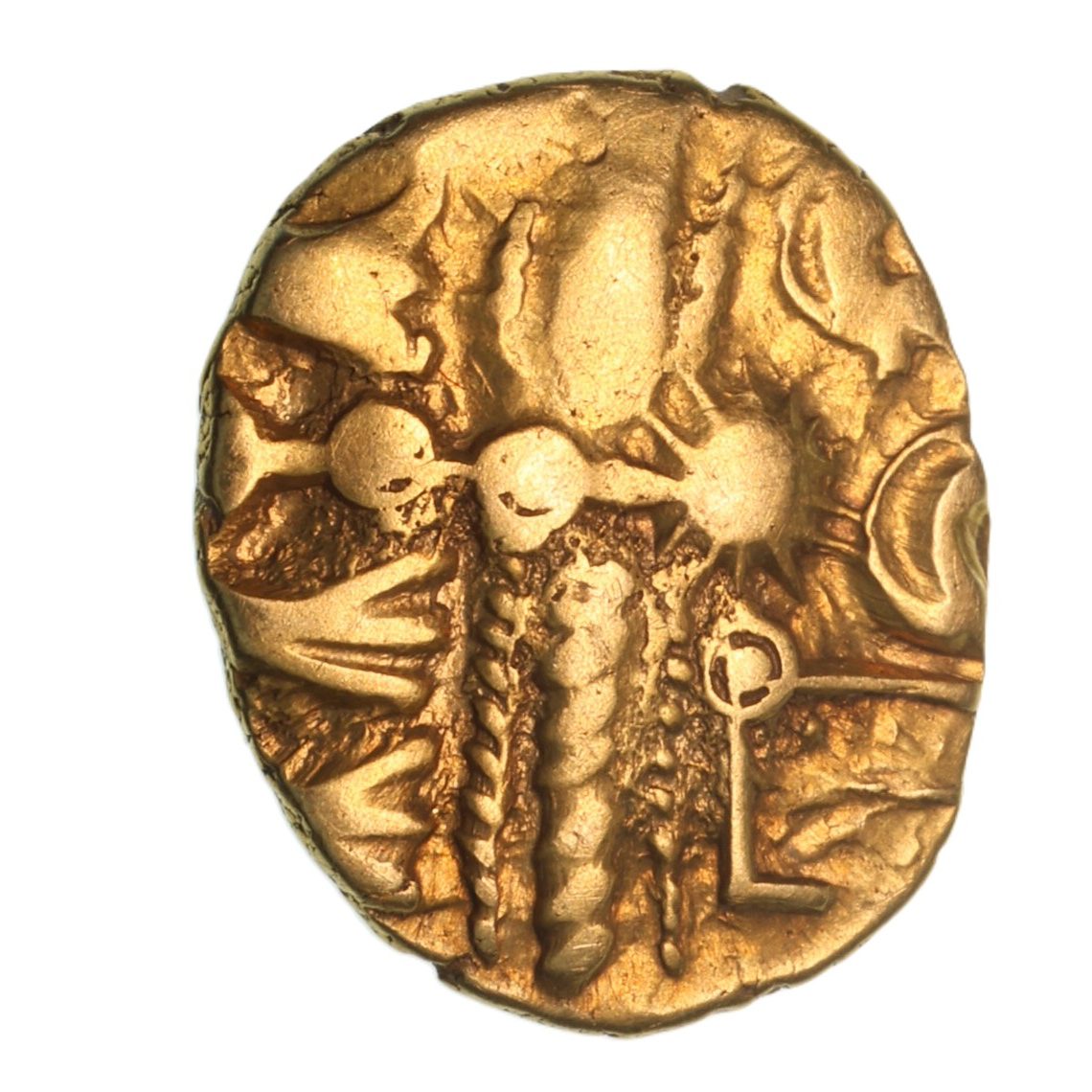
Obverse
Apollo wreath. Spike with three large pellets and sunburst across. Crescents below.
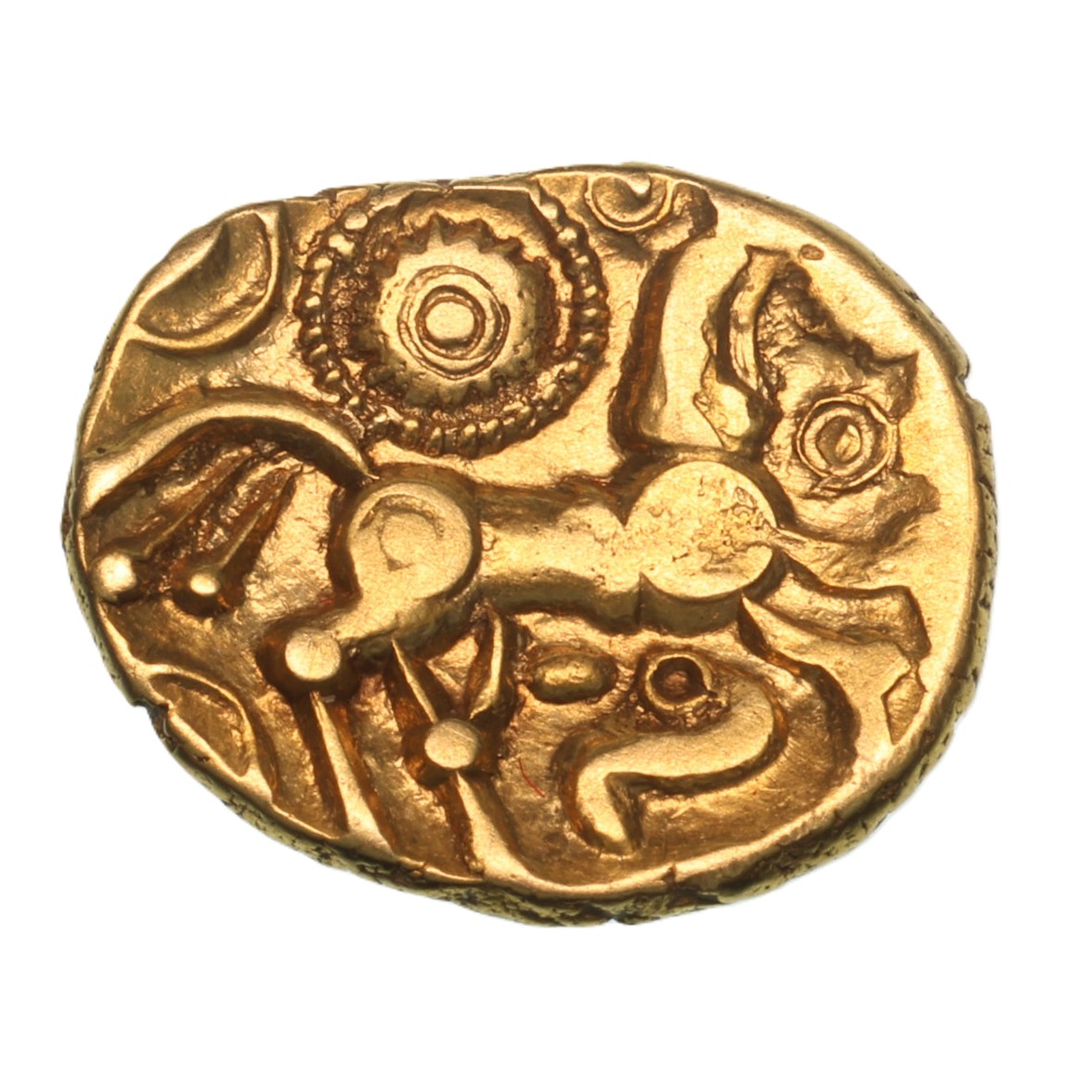
Reverse
Triple-tailed annulate horse right with necklace and belt, bifurcated back leg. Large cogwheel sun (cogwheel with large pelleted ring around) above. Small animal (stylised foal) below. Ringed pellets above and below neck.
Comments
Evans: B15 (1864, p. 70, pl. B).
Evans: L6 (1890, p. 452, pl. L).
Allen Type: British Rb.
Van Arsdell Classification: Dobunnic A, Early Uninscribed Coinage. Van Arsdell lists two varieties, the first (VA 1010-01 with wreath obverse) he says awaits discovery (despite there being many in the Celtic Coin Index) and the second (VA 1010-03) where the obverse die has been worn plain.
Healy Phase 1:
COD 4a ‘Two Ringed Pellets’ (ABC 2009; VA 1010-01). Wreath on obverse. Two ringed pellets around horse. 48 known.
Provenance
This coin is from The London Collection of Ancient British Coins. For more information click here: The London Collection – Silbury Coins : Silbury Coins.
M Vosper FPL 87, no 14, Nov 1995. Found South of Bristol VA1010-1
This coin comes with a previous label.
The Dobunni, the most westerly coin-issuers of Late Iron Age Britain, had a key zone of influence centred around what is today the Cotswolds – encompassing modern Gloucestershire, Worcestershire, parts of Oxfordshire and the lower Severn valley. Ptolemy places them firmly in and around Roman Corinium (modern Cirencester), although their original capital was probably located a few miles away at Bagendon – a massive site with huge enclosure ditches that was abandoned in about AD 60.
The earliest Dobunnic types are a small, restricted series of uninscribed gold coins perhaps issued in the period 50–20 BC, characterised by examples contained within the small hoard recovered in 1993 at Pershore, Worcestershire. These, along with many of their inscribed cousins, appear to partially overlap with a very extensive, uninscribed silver coinage first classified by Robert Van Arsdell – types such as the so-called ‘Cotswold Cock’ (ABC 2012/BMC 2950–1), ‘Cotswold Eagle’ (ABC 2015/BMC 2953–62) and ‘Cotswold Oxo’ (ABC 2024/BMC 2976–80).
Dobunnic coinage possesses a strong sense of regionalism in its artistry, having a relatively restricted, perhaps even conservative decorative range. There are no hints of agricultural prowess, as hinted at by the plentiful corn-ears rendered on Cunobelin’s gold staters and quarter-staters. Neither are there mint-names, as can be found proudly declared on issues of Calleva and Verlamion. Most certainly absent are both Latin titles such as ‘REX’ (king) and images from the Classical world; sphinxes, centaurs, griffins and wine-cups – as encountered on the silver coins of Cunobelin, Tasciovanus and Verica.
Out of stock
You may also be interested in these…
Related products
-
Celtic Gold Quarter Stater Dobunni Corio 20BC-5AD
£890.00Code: LC789
-
Celtic Gold Stater East Wilts Savernake Forest Type 1st Century AD
£625.00Code: LC82
-
Dobunni Corio 20 BC – AD 5 Gold Quarter Stater Extremely Rare
£1,250.00Code: EC207
-
Celtic Gold Stater Dobunni Eisu 35-30BC
£1,500.00Code: CDB29