
Catuvellauni Tasciovanos c. 25 BC-AD 10 Warrior Gold Stater *Scarce*
£6,750.00
Catuvellauni Tasciovanos c. 25 BC-AD 10 Warrior Gold Stater
Scarce
ABC 2562 (plate coin), 17mm, 5.48g
An exceptional coin, sharp detail and perfectly centred on both sides.
Obverse
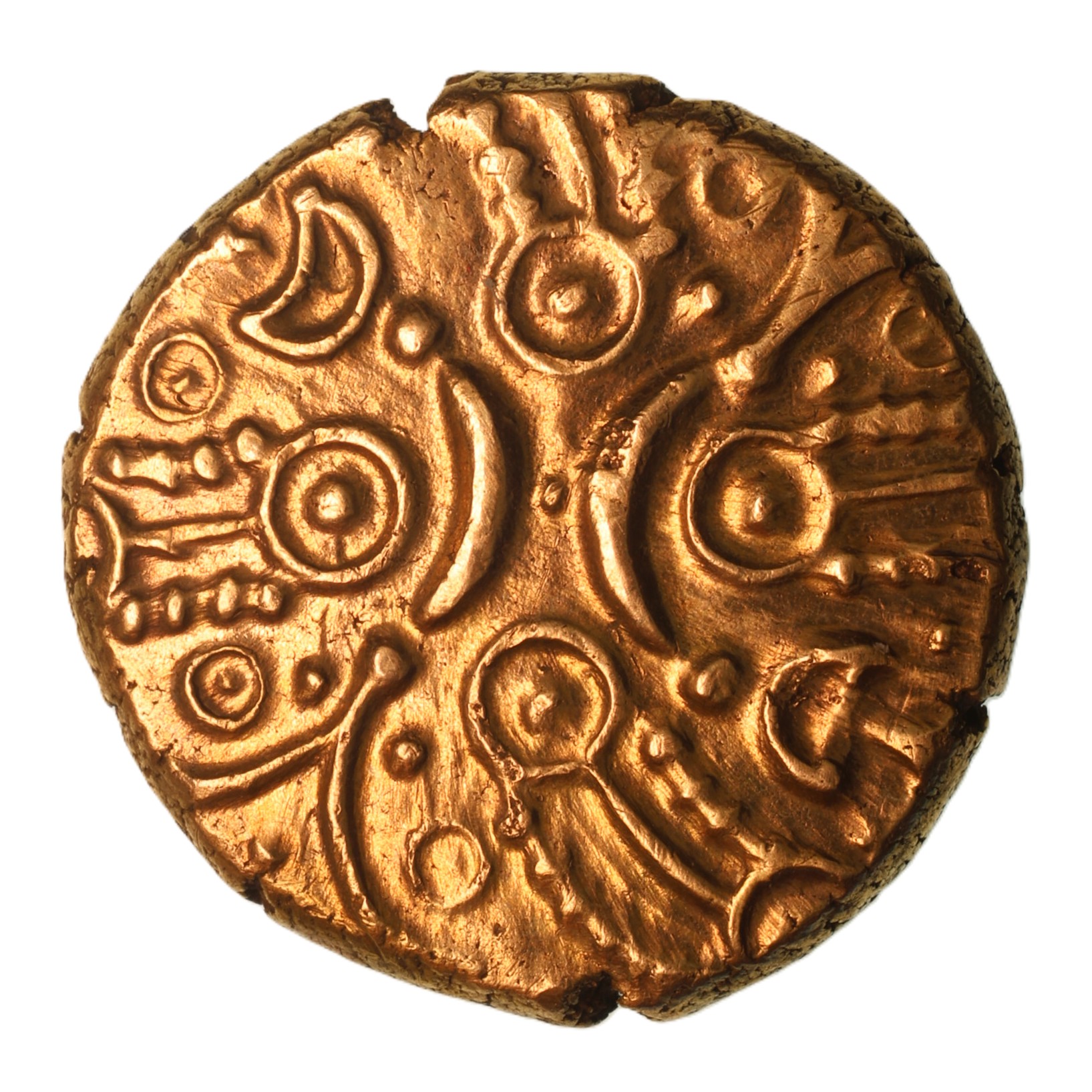
Cruciform design with crossed wreaths, the vertical wreath (when central crescents standing) is curved with the apex facing clockwise, both wreaths have large ringed pellets at each end. In the centre, long, thin back-to-back solid crescents with pellets at each tip separated by one, two or three pellets. Splayed V-shape with pellet at bottom and above in opposing angles. ‘Hidden face’ (linear crescent mouth, V-shaped forehead, pellets either side and below) in other angles.
Reverse
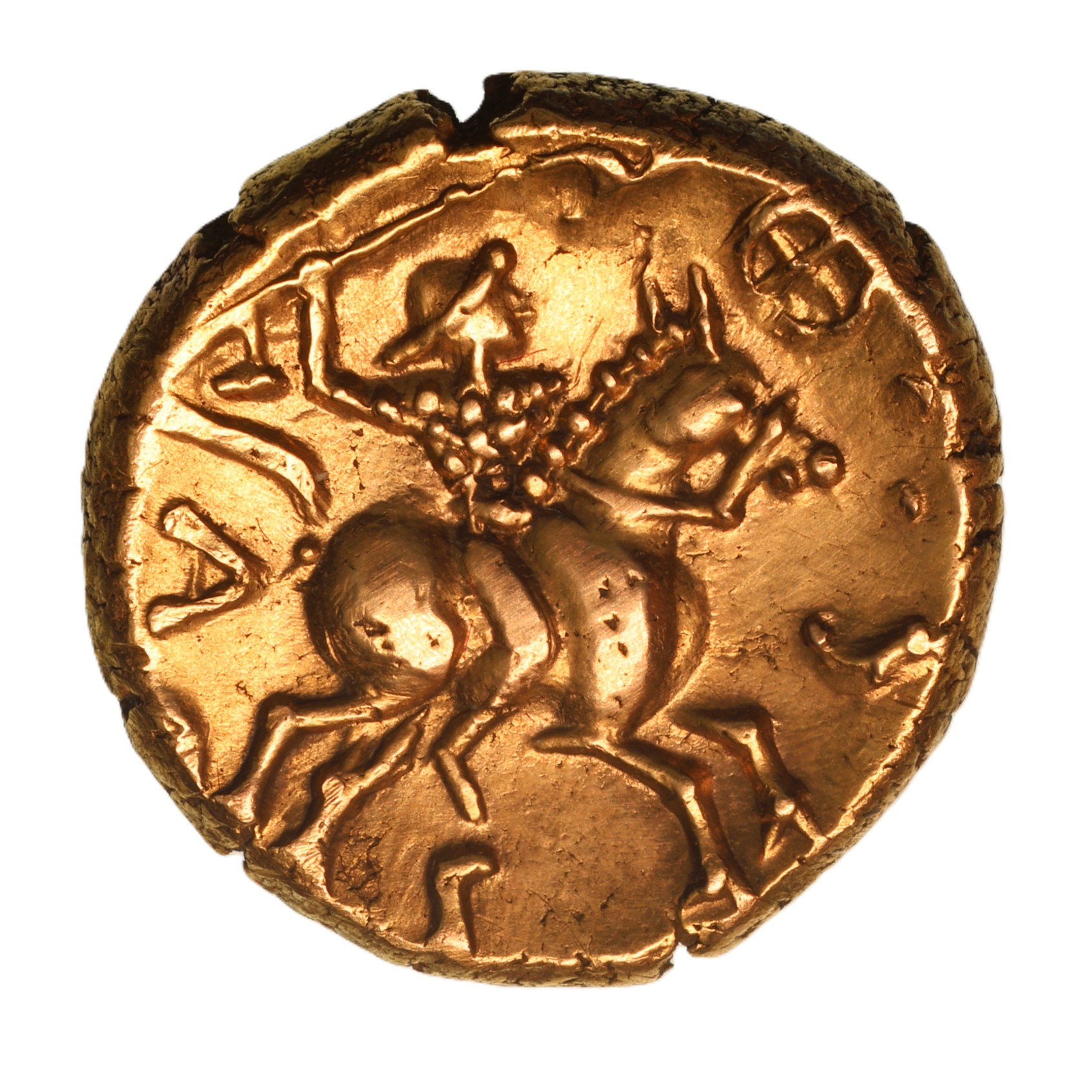
Warrior holding carnyx riding rounded horse right with tail lifted high. Five-spoked wheel behind rear legs and above head. T A S C inscription around the horse, starting above the tail, continuing below the tail, under the horse and ending in front. Single exergual line.
View Video Here
Comments
Evans: V.10 (1864, p. 231, pl. V).
Evans: XX.11 (1890, p. 541, pl. XX).
Van Arsdell Classification: Trinovantian N, Earlier Dynastic Issues, Tasciovanus Second Coinage. VA 1732 – 09: One pellet between crescents.
Sills Carnyx, Rotated Cross, High Tail (3 obverse, 4 reverse dies): North Thames Coinage; Type: Tasciovanos; Staters: Class 6b – Carnyx, Rotated Cross, High Tail. Similar to Carnyx, Rotated Cross, Low Tail (Sills DK 509) and shares a recut reverse die, but the horse’s tail is lifted (the shadow of the low tail can sometimes be seen, as can the old A below the horse). Very similar to Carnyx, High Tail Plain with rotated wreath (Sills DK 507) but on Sills Carnyx, Rotated Cross, High Tail the crescents are thinner, there are sometimes one or two dots between them, and the ‘hidden faces’ have linear crescent mouths instead of solid crescents. The dies are often flawed.
Sills DK 510: Vertical wreath curved anticlockwise. Three tiny pellets above horse’s front legs.
Sills chronology: Gallo-Belgic Ca – British G (Early Clacton) / Aa Westerham – British La (Whaddon Chase) – British Lb (Westbury) – Addedomaros – Dubnovellaunos – Tasciovanos.
Most of Tasciovanos’s Second Coinage is likely to have been struck at Verlamion.
Provenance
This coin is from The London Collection of Ancient British Coins. For more information click here: The London Collection – Silbury Coins : Silbury Coins.
C Rudd FPL 102, no 43 (2008). CCI 08.9306 Kretz type A/BI/IIA. ABC Plate coin VA1732-9
This coin comes with a previous label.
Tasciovanos (c. 25 BC–AD 10)
Following on from Addedomaros, who may or may not have been his father, we find Tasciovanos – whose coinage is some of the most complex and extensive within the North Thames series. An apparently long-lived ruler, traditional narratives of the Late Iron Age cast him as a dynamic and decisive individual who laid the groundwork for the success of his own son, Cunobelin, by extending Catavellaunian influence eastwards into East Anglia and Kent. While his coins generally take influence from indigenous art styles, some ‘classification’ is visible (though to a relatively limited degree) on specific types within his issues of silver and bronze. Some of the most impressive North Thames issues are exemplified by his gold staters, such as the ‘Tasciovanos hidden faces’ and ‘Tasciovanos warrior’ types (ABC 2553/BMC 1591–1603/ABC 2571/BMC 1615–16), both of which employ highly stylised, geometric motifs on their obverse faces. This medium also can be found on numerous examples of his bronze coinage, such as on the highly enigmatic ‘Tasciovanos Verlamio’ type. Here, the obverse depicts an eight-pointed star with the mint-name (VERLAMIO) cleverly interspersed between the points.
Out of stock
You may also be interested in these…
Related products
-
Early Uninscribed, Westerham Gold Stater 1st Century BC
£625.00Code: JC219
-
Catuvellauni Tasciovanus Gold Quarter Stater 25BC-25AD
£675.00Code: AC391
-
Catuvellauni & Trinovantes Cunobelin Bronze Unit 8-41AD High Grade
£265.00Code: AC397
-
Catuvellauni & Trinovantes Cunobelin Bronze Unit 8-41AD Metalworker High Grade
£300.00Code: AC396