
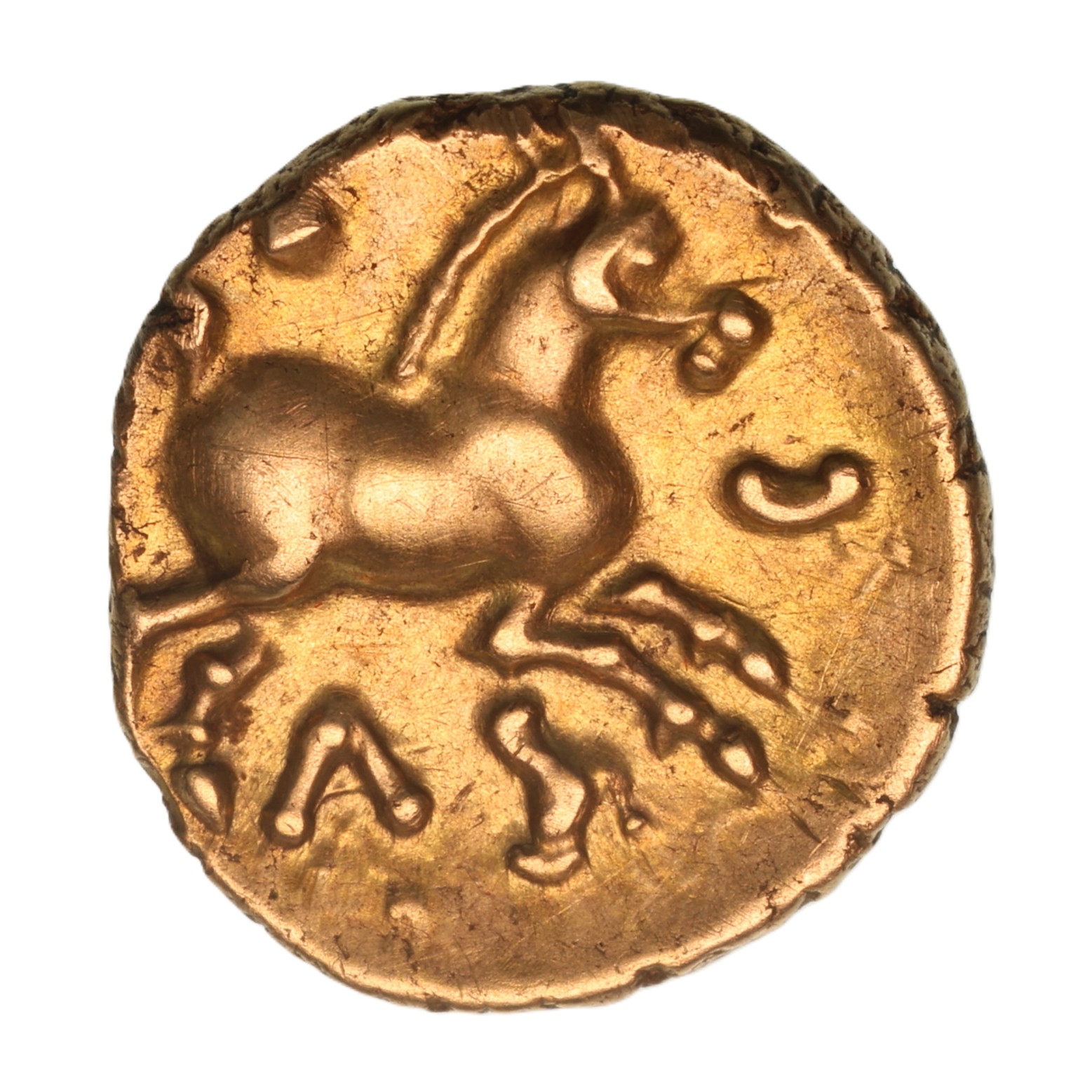
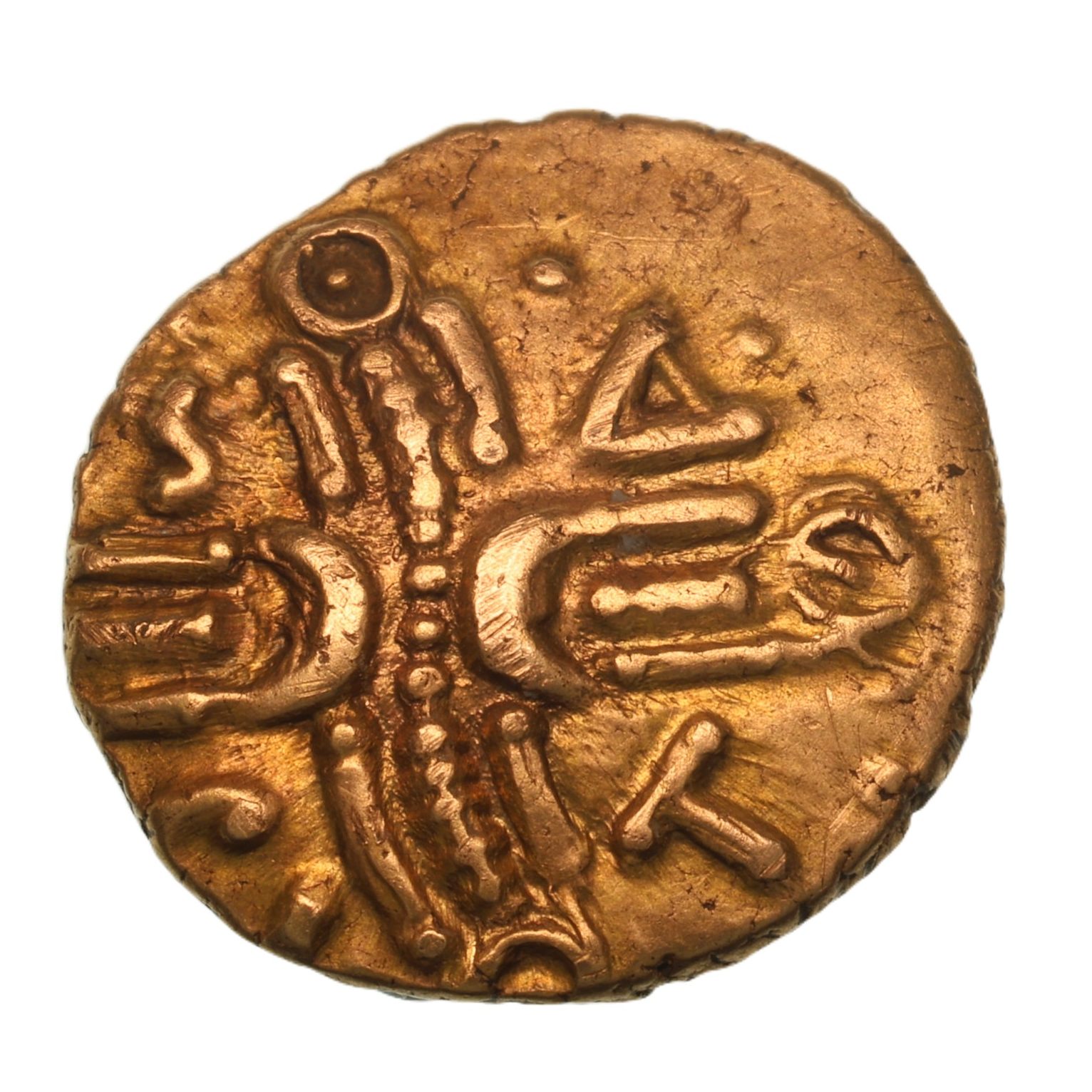
Catuvellauni Tasciovanos c. 25 BC-AD 10 Tasci Gold Quarter Stater *Rare*
£1,100.00
Catuvellauni Tasciovanos c. 25 BC-AD 10 Tasci Gold Quarter Stater
Cruciform design with crossed wreaths of two solid lines either side of a corded line, vertical wreath (when crescents standing) curved with the apex facing clockwise, horizontal wreath straight. Back-to-back solid crescents at centre, spaced widely. Ringed pellets at end of each wreath on the outside, not the centre. Inscription in angles with pellets – T-A-S-CI
Horse with pellet mane and plain, lifted tail right. Bucranium above. Inscription behind, below and in front – T-AS-C
Rare, this variant with ‘TASCI’ inscription on obverse Extremely rare (10 known).
ABC 2595; 12mm, 1.36g
Evans: V.13 (1864, p. 234, pl. V).
Van Arsdell Classification: Trinovantian M, Earlier Dynastic Issues, Tasciovanus First Coinage.
Kretz Type B var. 3-4.
Sills TASCI/TASC (3 obverse, 1 reverse dies): North Thames Coinage; Type: Tasciovanos; Quater Staters: Class 6b – TASC(I)/TASC. Obverse as Ring Horse Right (Sills 528) but with inscription rather than ringed pellets, some of the dies being shared but recut.
Sills DK 531: Three pellets between crescents; TASCI.
Sills chronology: Gallo-Belgic Ca – British G (Early Clacton) / Aa Westerham – British La (Whaddon Chase) – British Lb (Westbury) – Addedomaros – Dubnovellaunos – Tasciovanos.
Provenance
This coin is from The London Collection of Ancient British Coins. For more information click here: The London Collection – Silbury Coins : Silbury Coins
C Martin Nov 1993 Kretz type B, var. 4 VA 1692-1 var.
This coin comes with a previous label.
Tasciovanos (c. 25 BC–AD 10)
Following on from Addedomaros, who may or may not have been his father, we find Tasciovanos – whose coinage is some of the most complex and extensive within the North Thames series. An apparently long-lived ruler, traditional narratives of the Late Iron Age cast him as a dynamic and decisive individual who laid the groundwork for the success of his own son, Cunobelin, by extending Catavellaunian influence eastwards into East Anglia and Kent. While his coins generally take influence from indigenous art styles, some ‘classification’ is visible (though to a relatively limited degree) on specific types within his issues of silver and bronze. Some of the most impressive North Thames issues are exemplified by his gold staters, such as the ‘Tasciovanos hidden faces’ and ‘Tasciovanos warrior’ types (ABC 2553/BMC 1591–1603/ABC 2571/BMC 1615–16), both of which employ highly stylised, geometric motifs on their obverse faces. This medium also can be found on numerous examples of his bronze coinage, such as on the highly enigmatic ‘Tasciovanos Verlamio’ type. Here, the obverse depicts an eight-pointed star with the mint-name (VERLAMIO) cleverly interspersed between the points.
Out of stock
You may also be interested in these…
Related products
-
Catuvellauni & Trinovantes Cunobelin Plastic Type Gold Quarter Stater 8-41AD
£425.00Code: JC517
-
Celtic Gold Stater Catuvellauni Tasciovanus 25BC-25AD
£2,650.00Code: LC815
-
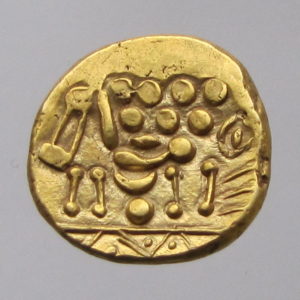
Celtic Gold Stater Westerham Type 50BC
£940.00Code: WE04
-
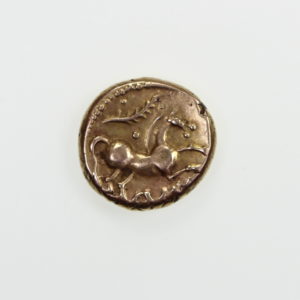
Catuvellauni & Trinovantes Cunobelin Linear Type Gold Stater 8-41AD
£995.00Code: DC930