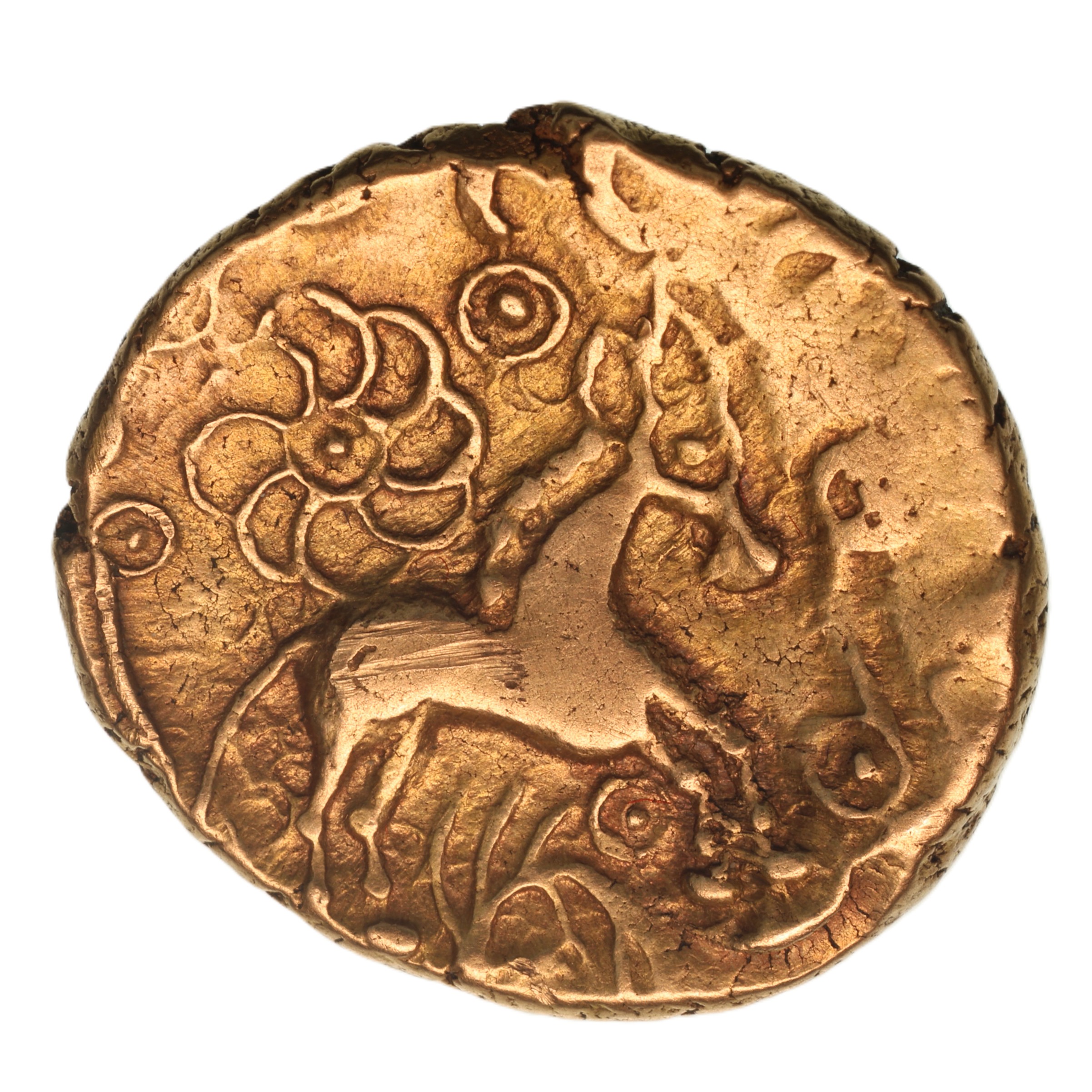
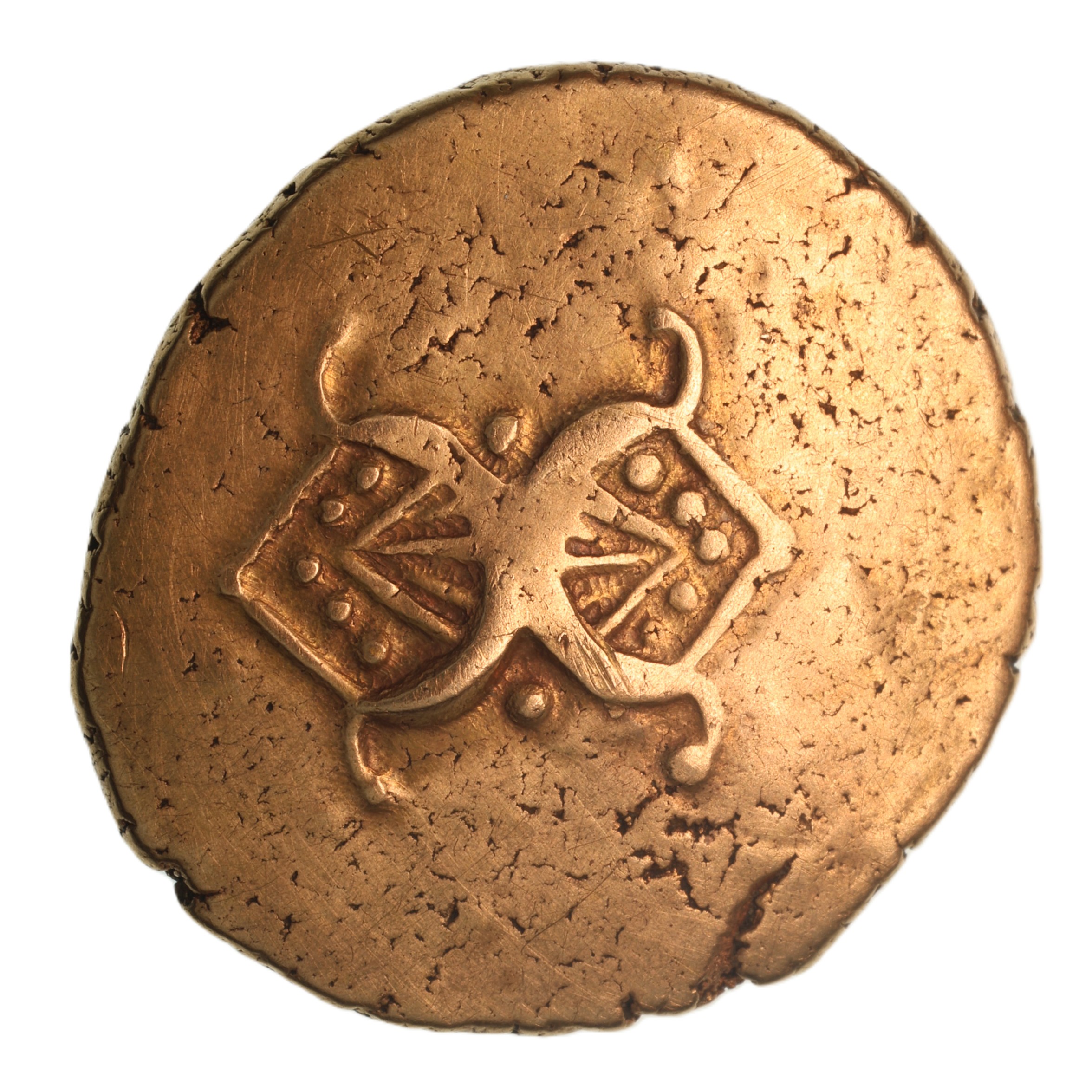
Catuvellauni Addedomaros c. 45–25 BC Floral Spiral Normal Type Gold Stater *Rare*
£1,950.00
Catuvellauni Addedomaros c. 45–25 BC Floral Spiral Normal Type Gold Stater
Back-to-back crescents with arcs at the points, pellets between crescent arms, projecting chevron (three or five lines) and pellet design inside, on plain field.
Small annulate horse right with mane, neck either solid or of short upturned bars, and spindly legs. Spiral sun (wheel-like clockwise whorl) above. Branch (frond) below. Ringed pellet in front. Inscription around.
Rare
ABC 2511; 19mm, 5.53g
Evans: XIV.1 (1864, p. 367, pl. XIV).
Evans: XIV.3 (1864, p. 370, pl. XIV).
Van Arsdell Classification: Trinovantian K, Earlier Dynastic Issues, Addedomaros Third Coinage. VA 1635 – 01: Pellets and 5 lines in crescents.
Sills DK 484 (4 obverse, 12 reverse dies): North Thames Coinage; Type: Addedomaros; Staters: Class 1b – Shell Whorl. Uses an obverse die from Shell Inner Circle (ABC 2508). The reverse is similar to Shell Inner Circle without the circles around the obverse or around the whorl, and less carefully engraved letters.
Addedomaros could be Trinovantian or Catuvellaunian, or a ruler of both. His staters are similar to the Essex Banded, north-eastern coins with Cantian influence. They follow the sequence Shell – Crescent Cross – Spiral. The frond on Addedomaros Shell and coins of Dubnovellaunos in Essex and Tasciovanos may be a family emblem.
Sills chronology: Gallo-Belgic Ca – British G (Early Clacton) / Aa Westerham – British La (Whaddon Chase) – British Lb (Westbury) – Addedomaros – Dubnovellaunos – Tasciovanos.
Provenance
This coin is from The London Collection of Ancient British Coins. For more information click here: The London Collection – Silbury Coins : Silbury Coins
Spink PT June 1994 VA 1635-1
This coin comes with a previous label.
Addedomaros (c. 45–25/10 BC?)
Addedomaros appears to have been the first ruler in the north Thames sequence to place his name upon coins, perhaps a contemporary of his southern counterpart, Commios. His earliest coins, probably struck during the earlier 30s BC, are intriguingly of very similar general appearance to the uninscribed ‘Wonersh’ staters of the Atrebates – though their reverses bear a variation on the Latin inscription ‘ADDEDIIDOM’ (ABC 2514/BMC 2390–94). Some coins attributed to Addedomaros have been undertaken on stylistic grounds rather than their explicitly bearing his name, such as the increasingly common ‘Addedomaros flower’ quarter staters (ABC 2526/BMC 2416). His coins are generally found in Hertfordshire, Cambridgeshire and Essex, though a number were found in the recent ‘Near Blythburgh’ hoard, buried in north east Suffolk. He is potentially the occupant of the so-called ‘Lexden tumulus’, a high-status Late Iron Age barrow burial from near Colchester, dating c. 15–10 BC. Amongst other things, the tomb contained a silver medal depicting the Roman emperor Augustus, a table and pieces of monumental statuary in bronze – suggesting its occupant was well engaged with trade networks and contacts from the Mediterranean world.
Out of stock