Catuvellauni 1st Century BC Whaddon Wings Gold Quarter Stater *Extremely Rare*
£2,950.00
Catuvellauni 1st Century BC Whaddon Wings Gold Quarter Stater
Extremely Rare, 17 known.
ABC 2457, 15mm, 1.44g
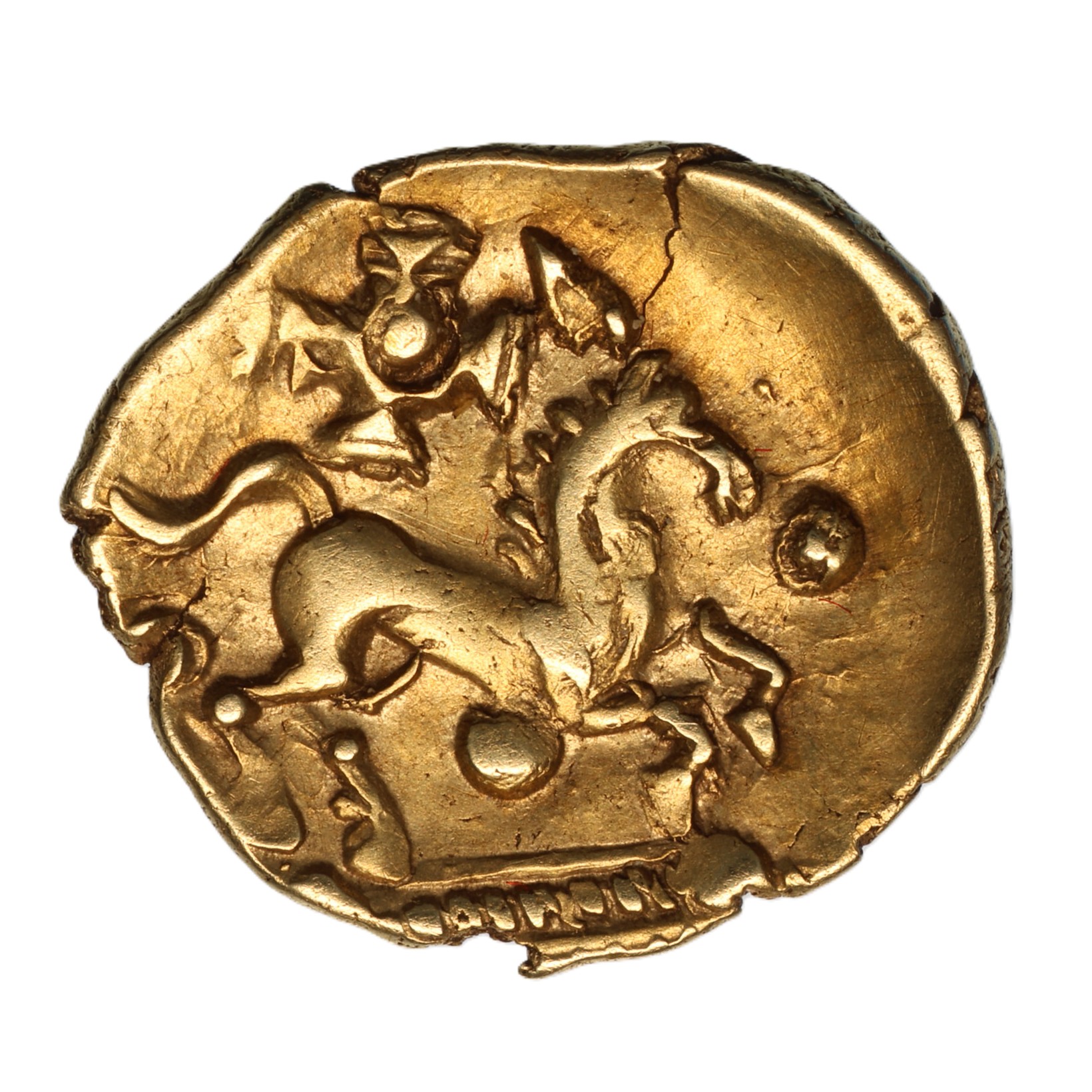
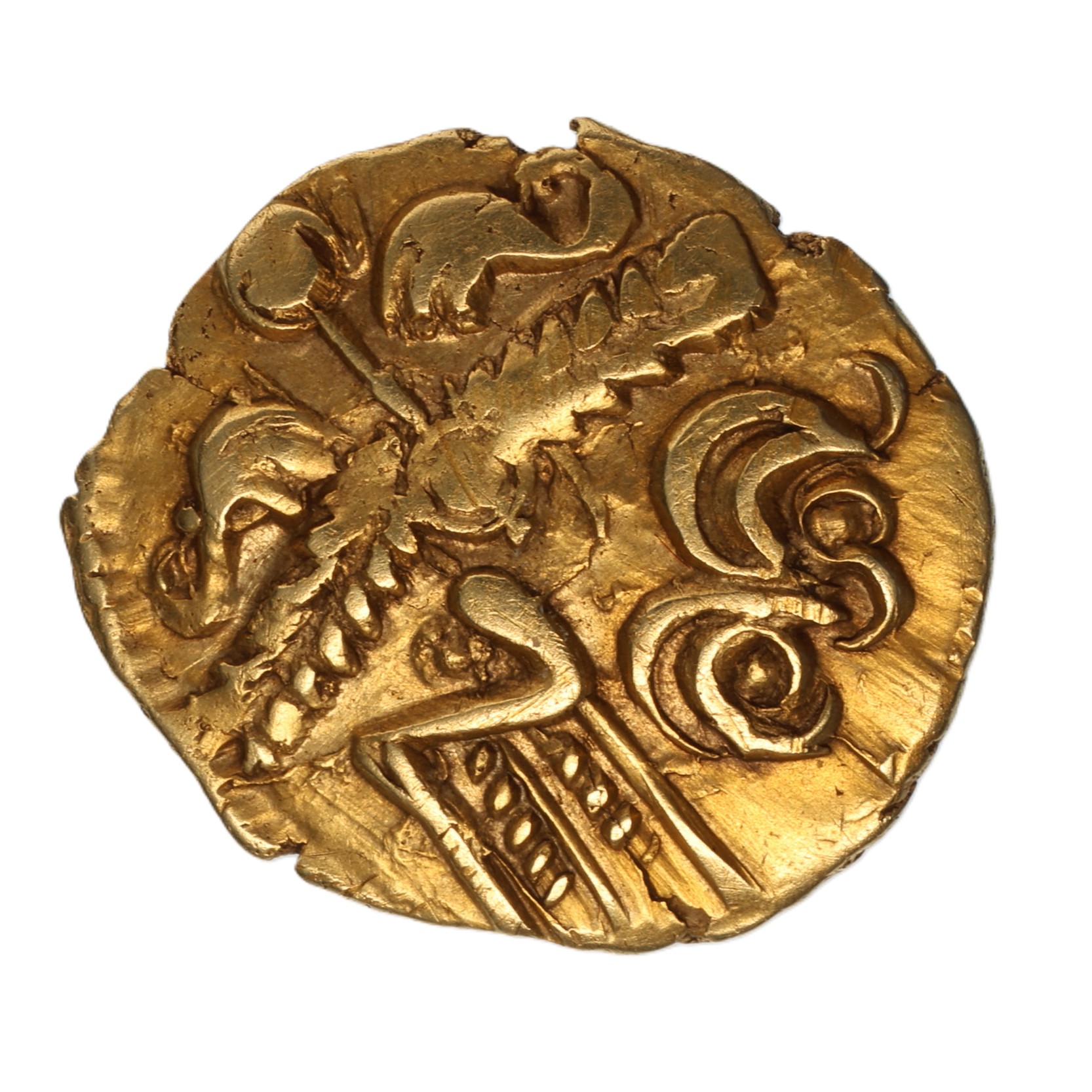
Well struck on a large flan showing all die detail, seldom seen in this series.
Obverse
Abstracted head of Apollo right. Wreath is bent at an angle at the point it intersects the hairbar. Open linear crescents to right, unenclosed, tilted backwards. Cloak below with backwards S at left hand edge. Spike (hairbar) has two pellets, one on the end in the centre. Rounded, comb-like hair curls (wing-like motifs) to left of wreath.
Reverse
Naturalistic horse with oversized ear right, mane of small dashes, single-strand tail. Cross pattée with ringed pellet at centre (Maltese cross) above, sometimes degraded to a flower of lines. Pellet sun (ring-and-large-pellet, which can look like one large pellet when worn) below.
View Video Here
Comments
Van Arsdell Classification: Trinovantian D, Later Uninscribed Gold Coins, Whaddon Chase Type. Van Arsdell lists varieties:
VA 1478 – 03: Large pellet below horse. Flower of lines above. This is Sills DK 465.
Rudd (ABC) ‘Whaddon Wings’.
Sills Whaddon Cross (12 obverse, 13 reverse dies): Early North-West Thames Coinage; Type: British La2; Quarter Staters: Class 1 – Cross. The obverse comes from British Qc (ABC 500) with an angled wreath. Associated with the Early Whaddon Chase stater (ABC 2433) which has similar hair curls, and with Whaddon Chase (Sills 458), which has the crescents are tilted backwards and unenclosed.
Sills DK 465 (VA 1478-03): Cross above horse is degraded.
Sills chronology: Gallo-Belgic Ca – British G (Early Clacton) / Aa Westerham – British La (Whaddon Chase) – British Lb (Westbury).
Provenance
This coin is from The London Collection of Ancient British Coins. For more information click here: The London Collection – Silbury Coins : Silbury Coins.
G Hilton (15.03.2010). T Carter coll. VA1478-1
This coin comes with a previous label.
Catuvellaunii
Maintaining influence over a broad swathe of the North Thames region, running broadly from Essex in the east to Oxfordshire in the west, the Trinovantes and Catuvellaunii have traditionally been considered as separate entities. This view was largely based on the writings of Julius Caesar, who vividly described the tactics of his opponent, the Catuvellaunian chieftain Cassivellaunos, as well as detailing the warlike ambitions he imposed upon his neighbours. However, this perspective of constant warfare between two neighbouring groups is now considered somewhat inaccurate. Instead, the picture appears to have been much more complex, with some scholars of the period going so far as to suggest the two groups were united both politically and economically by the middle of the 1st century BC. One suggestion mooted by Robert van Arsdell is that a period of initial unity was followed by some kind of extended interregnum, during which several coin-issuing figures competed for influence. This in turn came to pass following the success of Cunobelin, with whose accession cohesion was once again achieved.
Nevertheless, that the two groups existed and once appear to have been independent seems undeniable. The Catuvellaunii probably lived mainly in and around what are now the counties of Bedfordshire and Hertfordshire. Their capital, Verlamion, still survives to this day – a heavily fortified location with impressive earthworks, sited some two kilometres away from the modern city of St Albans. Meanwhile, the Trinovantes were settled further east. Located firmly within what we might call southern East Anglia, their core territory seems to have comprised a substantial portion of modern Suffolk and Essex. The major settlement of Camulodunon represented their main power-base, which would be subsequently developed by the Romans into Britain’s first town – Colchester. Both these locations are known as Late Iron Age mints, their products inscribed ‘VER’ and ‘CAMV’ respectively.
The earliest issues of the North Thames region are characterised by the so-called ‘Whaddon Chase’ staters and their derivatives, an uninscribed coinage named after the Buckinghamshire site where a very large hoard was found in the 19th century. These may well have been struck in the late 50s or early 40s BC to pay tribute in the aftermath of Caesar’s expeditions to Britain. A diversification in the uninscribed issues via the striking of silver and, more rarely, bronze, is followed in the 30s BC by the issuance of the earliest inscribed coinages. These form a distinct, trimetallic set of issues, suggesting that by this stage some sort of monetary economy may have developed in the North Thames Region. Output of coinage intensifies towards the end of the first century BC and into the first century AD, suggesting coin-use may well have become more widespread.
Out of stock
You may also be interested in these…
Related products
-
Celtic Gold Stater Catuvellauni Cunobelin 10- 20AD
£1,500.00Code: LC150
-
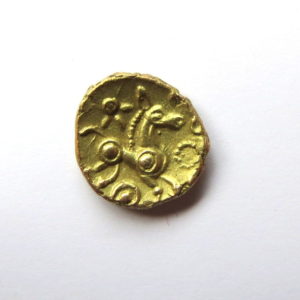
Catuvellauni, Raunds Wing Gold Quarter Stater 45-40BC Rare
£850.00Code: JC12
-
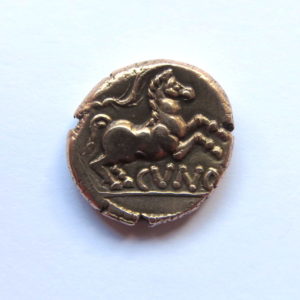
Celtic Gold Stater Catuvellauni Cunobelin 8-41AD Classic Type
£1,100.00Code: DC677
-
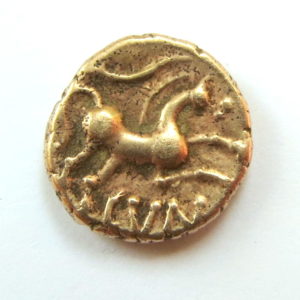
Celtic Gold Quarter Stater Catuvellauni Cunobelin 10-20AD
£425.00Code: CC35