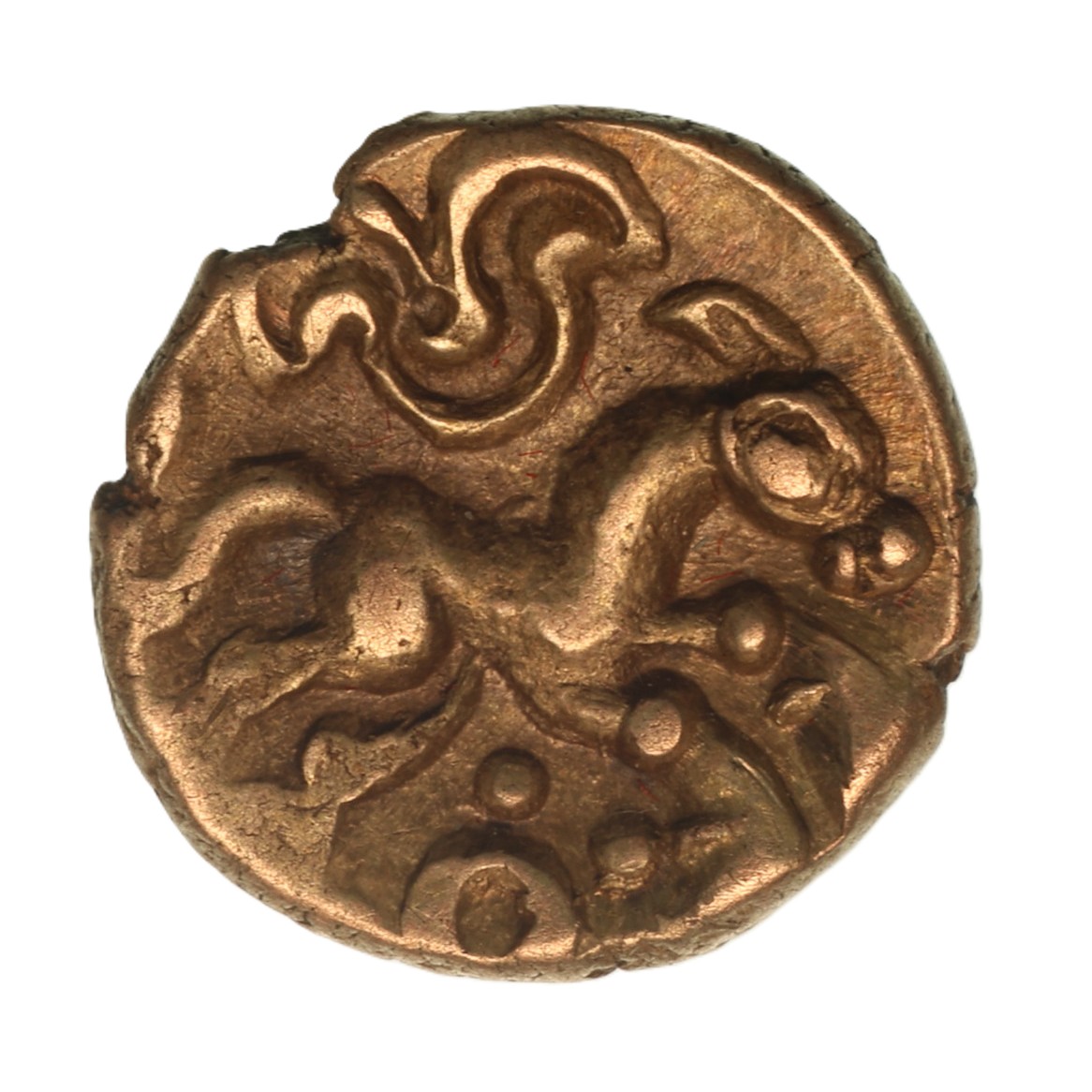
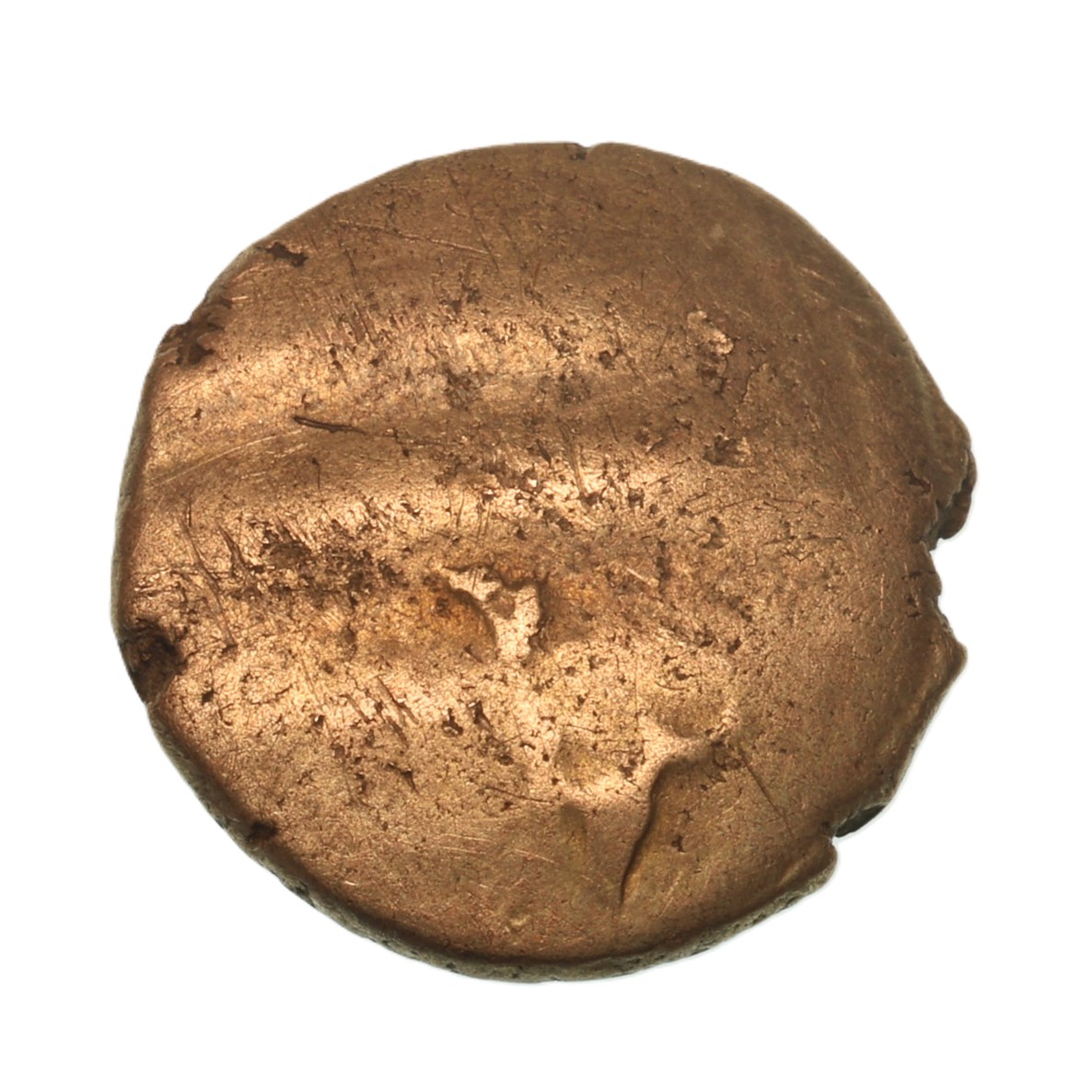
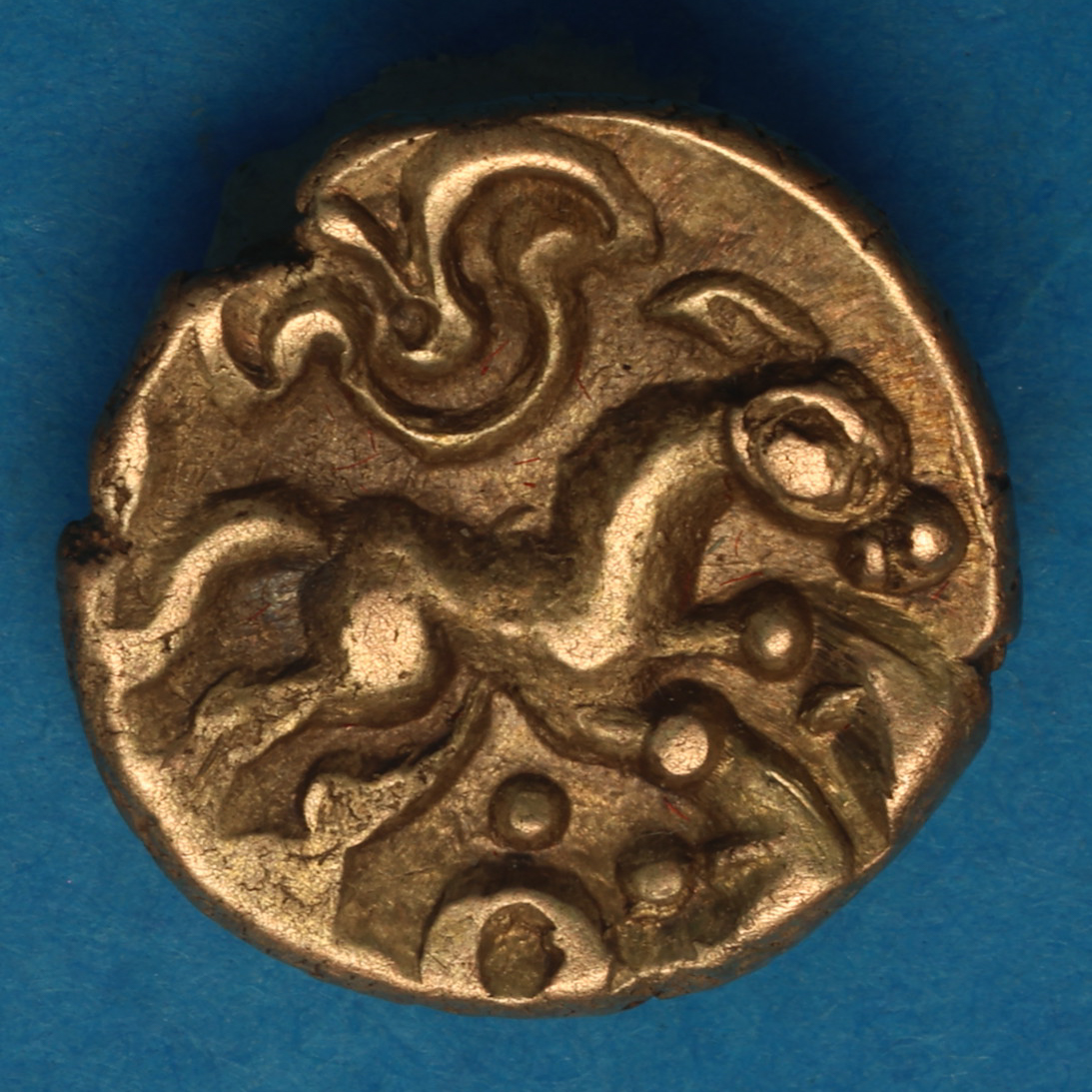
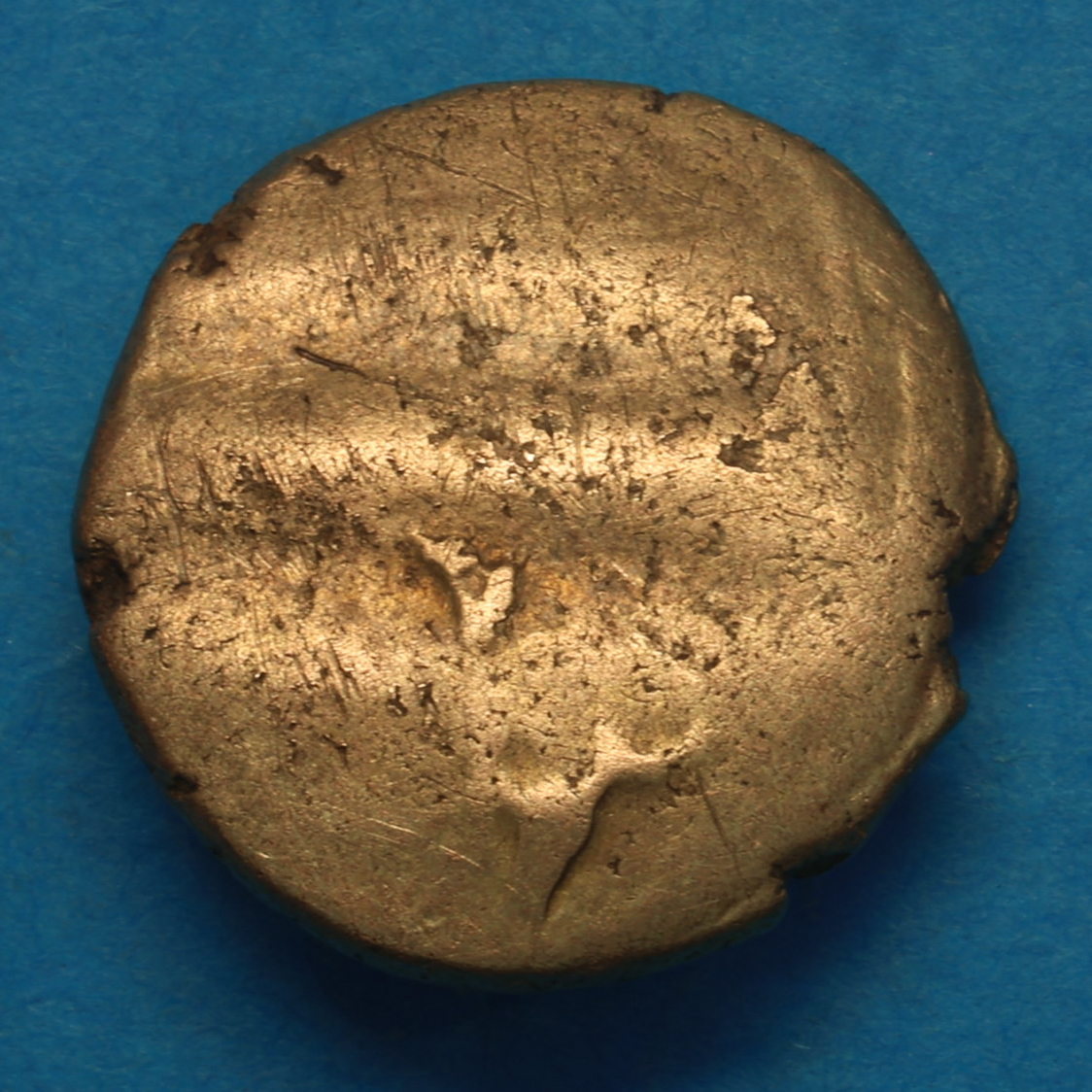
Cantiaci 1st Century BC Kentish Horse Brooch Gold Quarter Stater *Very Rare*
£1,350.00
Cantiaci
1st Century BC Kentish Horse Brooch Gold Quarter Stater
Very rare
ABC 201, 11mm, 1.34g
A pleasing example with much appeal in hand.
Obverse
Three raised bands on plain field.
Reverse
Horse without mane leaping right. U-shape motif above.
Comments
Evans: D10 (1864, p. 85, pl. D).
Allen Type: British Ly3.
Van Arsdell Classification: Cantian I, Uncertain Ruler “IVII”.
Sills DK 66 (1 obverse die, 8 reverse dies): Coinage of Kent, Uninscribed Issues; Type: Hand and Canopy Issues; Quarter Staters: Class 1 – Canopy. Sills says the crude, heavy Hand and Canopy issues were struck at a similar time to the finely-engraved, lighter Ribbon issues. The horse is a reduced version of the one on the staters, with a single backward-sloping ear but no pellet mane and no annulet n the shoulder. The canopy above is three U shapes, perhaps from the bull abofe the horse on ABC 216.
Provenance
This coin is from The London Collection of Ancient British Coins. For more information click here: The London Collection – Silbury Coins : Silbury Coins.
SNC FPL CII/7, no 5583, Sept 1994. VA158
This coin comes with a previous label.
Cantiaci
‘Of all the Britons the inhabitants of Kent, an entirely maritime district, are by far the most civilised, differing but little from the Gallic manner of life.’
Caesar, De Bello Gallico, book V, chapter 13.
The modern county of Kent was, according to the Romans, the homeland of the Cantiaci or Cantii. The closest portion of mainland Britain to the Continent, it is unsurprising that in the Late Iron Age the region boasted strong links with north-east France – a legacy maintained to this day, one could argue, with the continued importance of Dover and Folkestone as key cross-channel ferry ports.
Kent’s earliest Iron Age coins (and indeed, probably the earliest indigenously-produced British coins) are represented by cast bronze pieces called potins, whose alloy has a high tin content. On the basis of single finds and hoards, we know that imported gold in the form of Gallo-Belgic coinage was widely used in Kent at around the same time as the potins.
The somewhat mysterious series of uninscribed Kentish gold, including the so-called ‘Weald Net’ staters (ABC 177/BMC 2466) and ‘Corded Triangle’ quarter staters (ABC 198/BMC 2469–71) were probably struck c. 50–30/25 BC, they perhaps slightly precede a diverse group of uninscribed silver and bronze issues.
Inscribed issues belong towards the end of the Kentish coin-sequence, as is invariably the general case in Late Iron Age Britain. Their production probably began from c. 25 BC onwards and runs onward till shortly before the Claudian invasion. It is worth noting that at this time, Kent seems to have been taken over to varying extents by rulers from neighbouring regions. These rulers in turn came to issue coins in the region, even though they themselves might not originate from it, nor it reflect their main power-base.
1 in stock
You may also be interested in these…
Related products
-
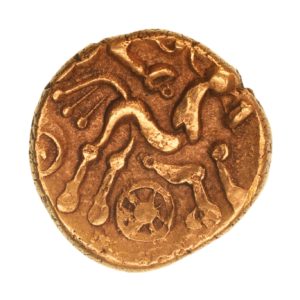
Regini & Atrebates c.60-50 BC Gold Stater Selsey Rings *Excessively Rare*
£2,250.00Code: QC864
-
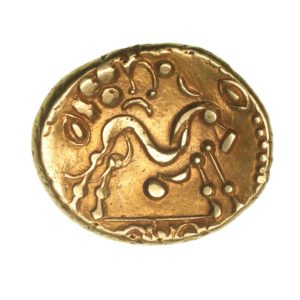
Gallo Belgic Ambiani 1st Century BC Gold Stater
£1,450.00Code: QC860
-
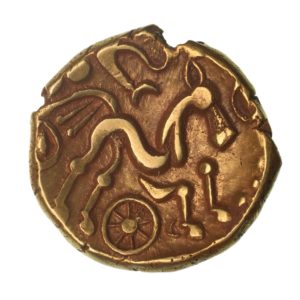
Regini & Atrebates 1st Century BC Selsey Two Faced Gold Stater *Scarce*
£1,650.00Code: IAC40
-
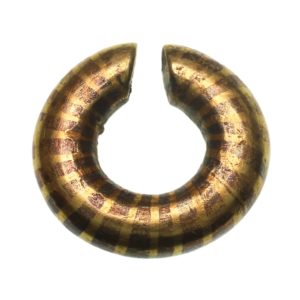
Iron Age 2nd Century BC Gold Banded Ring Money
£2,250.00Code: IAC201