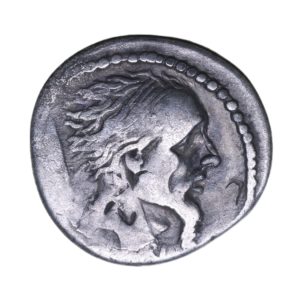
The Chilfrome Hoard
This small hoard of 97 Denarii was recovered from near the Dorset village of Chilfrome on the 21st March 2021 by Mr Trenton Oliver. Post excavation, the coins were delivered to the local Finds Liaison Officer (PAS DOR-41B389) and, following a declaration of the find as Treasure, transferred to British Museum (2021 T194). The hoard has subsequently been disclaimed and some of the coins are offered here for sale. Unlike the majority of recovered Romano-British hoards, Chilfrome lay for two thousand years undisturbed by agricultural activity and was found by Mr Oliver in a single tight nucleated group. Extensive metal detecting and a later archaeological excavation have produced no additional coins.
Chronologically, the hoard belongs to the beginning of the Romano-British period. A terminus post quem of AD 47 is provided by the single coin of Claudius in hoard. That coin’s lack of significant circulation wear and the absence of other contemporary or later issues makes a deposition date in the late 40s plausible.
The Legio II Augusta, commanded by Titus Flavius Vespasianus, was one of four legions sent across to Britain in AD 43 with the objective of subduing the barbaric island and securing for Claudius the triumph that his imperial reputation so desperately needed. Upon arriving at Richborough Legio Augusta turned west and progressed into Dorset against the Durotriges, a campaign which involved in the construction of fortresses and the occupation of Iron Age hill forts. The Chilfrome hoard was deposited right at the heart of this activity, lying almost equidistant between the important hill forts of Maiden Castle and Waddon Hill (about 12-14 km as the crow flies), and also close to the Roman road which ran from Dorchester up to the Mendip lead mines which the Legio II Augusta began to exploit in the late 40s.
The Chilfrome hoard is typical in containing a preponderance of worn Republican issues. These serve as a useful reminder of two monetary constants; that coins could, and often did, circulate for centuries; and that current issues often formed a small proportion of the total circulating medium. However, it is also true that the proportion of Republican coins found within the Chilfrome hoard is slightly lower than in other comparable first century British Hoards. The significance of this, if any, is unclear. The prevailing view now held is that a great many Republican Denarii entered Britain in the decades before AD 43. This comes as little surprise when we recall Strabo’s observation that British Iron Age tribes exported ‘grain, cattle, gold, silver, iron, hides, slaves, and dogs’. These Republican Denarii provided a supply of coinage which the Roman administrative bureaucracy could draw from as the army campaigned deeper into the interior of the island. No doubt many of the Republican Denarii from the Helmingham, Near Riskington and Norton Subcourse hoards had been in Britain for decades.
The Chilfrome hoard stands as a testament to the opening decade of the Roman-British period; geographically and chronologically it reflects the following their defeat of the Durotriges. We can never know for sure who buried it, but given its presence of Legio II Augusta, in the years following their defeat of the Durotriges. We can never know for sure who buried it, but given its location, the complete absence of any native specie, and the relatively high proportion of recent Imperial issues it is plausible that it represents an army stipendium, or pay packet.
Showing the single result