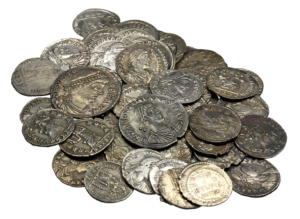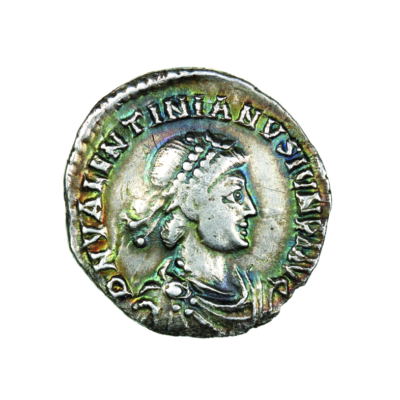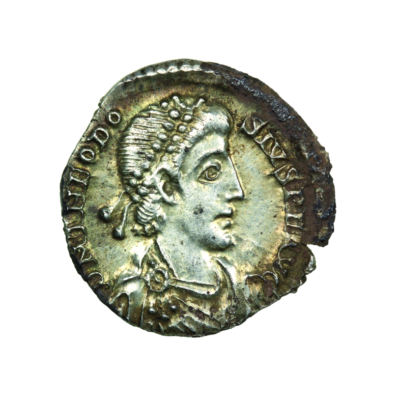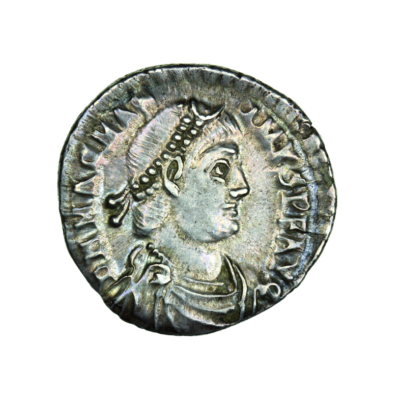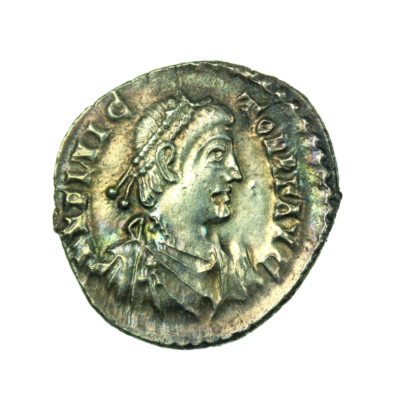
The Vale of Pewsey Hoard

From the final years of the 4th century and well into the 5th, a remarkable phenomenon essentially unparalleled anywhere else in the Roman empire began to occur in Britain.

Running across a swathe of the country extending from Yorkshire in the north, down to Norfolk in the east and then as far as Wiltshire in the west, people began to bury hoards. These varied wildly in size, materials and content. While some consisted small groups of clipped siliquae (late Roman silver coins), others were decidedly more extensive; sets of tableware in silver, bronze or pewter, hacked up objects of precious metal, and large mixed deposits of highstatus jewellery occurring alongside hundreds or thousands of silver and gold coins.

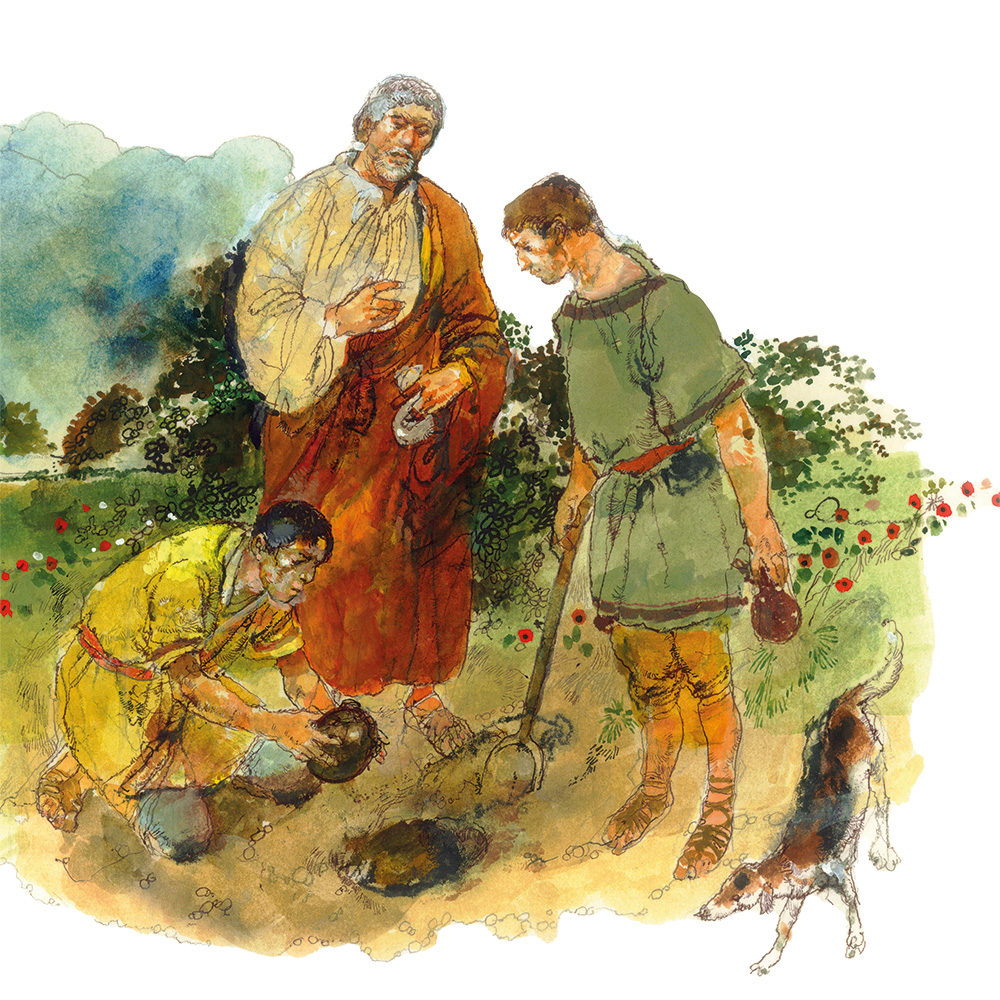
It is only too evident that these deposits were never recovered by those who buried them – with many not surfacing for many centuries until inadvertently dragged up by ploughshares or recovered by metal detectorists. Some interesting regional trends are visible. For example, hoards of silver tableware and objects tend to cluster in East Anglia, while deposits of solely gold or silver coins have their focus in the southwest (specifically Wiltshire). Finds such as those from Stanchester, Hoxne, Mildenhall, Water Newton, Patching, East Harptree and Gussage all Saints evoke familiar images of glittering treasure – coins, jewellery, lavish dinner services and bullion. Many of these have now been acquired for the public benefit by institutions, and indeed the Hoxne and Mildenhall treasures (to name two of the most famous) can today be seen in the British Museum.
 

View coins for sale

DISCOVERING THE VALE OF PEWSEY HOARD

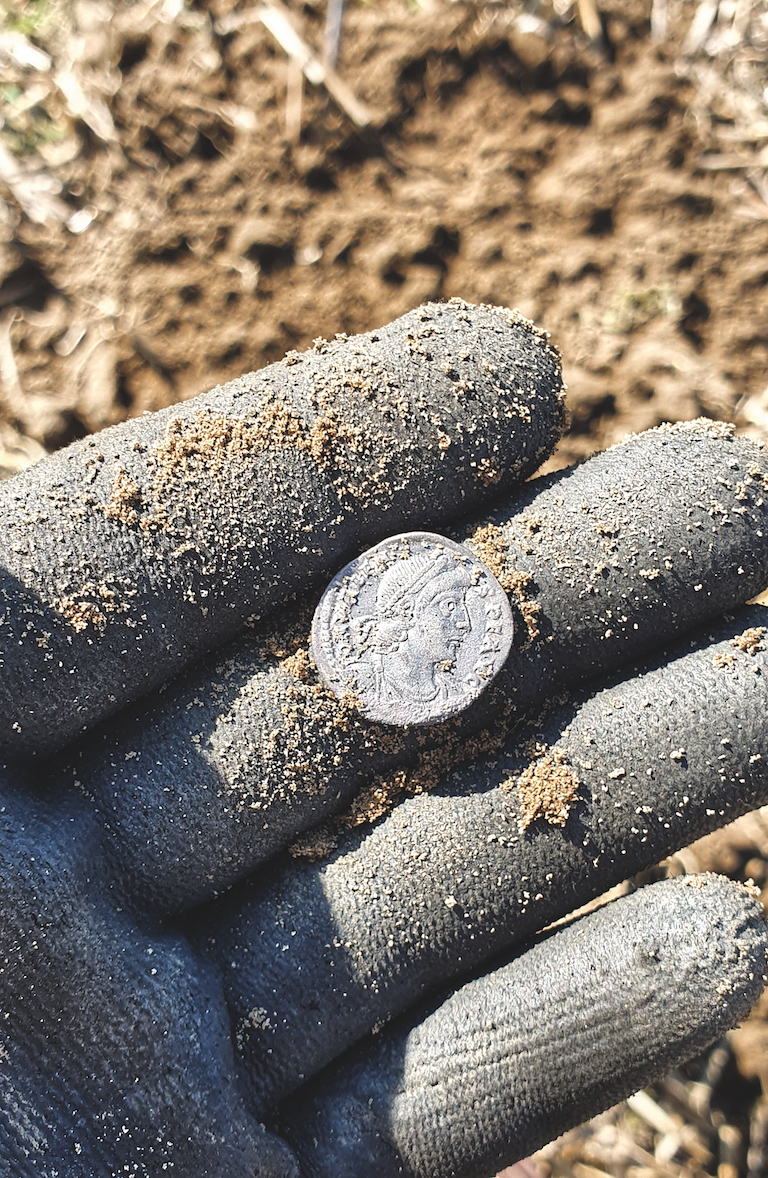
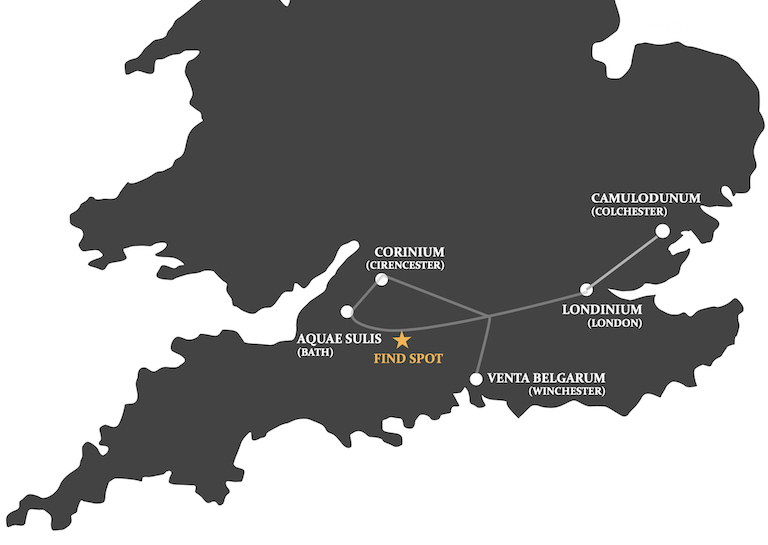
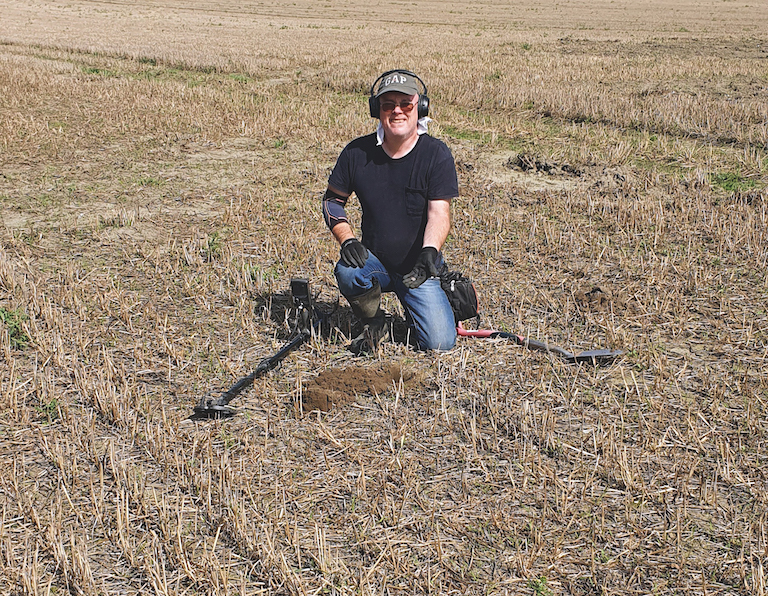
In September of 2020, three metal detectorists searching a ploughed field in the Vale of Pewsey, Wiltshire made a remarkable discovery.

On their first visit to the fields in question they had a weekend of fine weather so decided to camp overnight to extend their time searching. Rather unluckily, this chosen campsite covered the hoard site so this was not the trip which led to its discovery! Thankfully they returned to the area again and discovered, spread over their previous camp site a dense scatter of late Roman silver coins, clearly representing a hoard which had been ploughed out of its archaeological context by modern agriculture. Search conditions were difficult due to long stubble left by the combine but with specialist small search heads for their metal detectors the three friends were able to locate coins at a depth up to 14 inches.

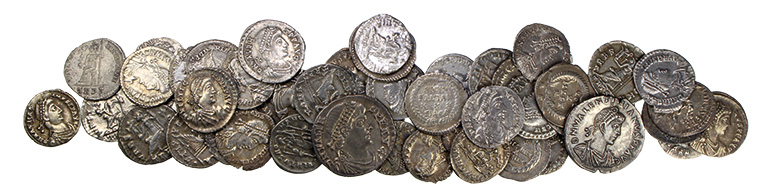
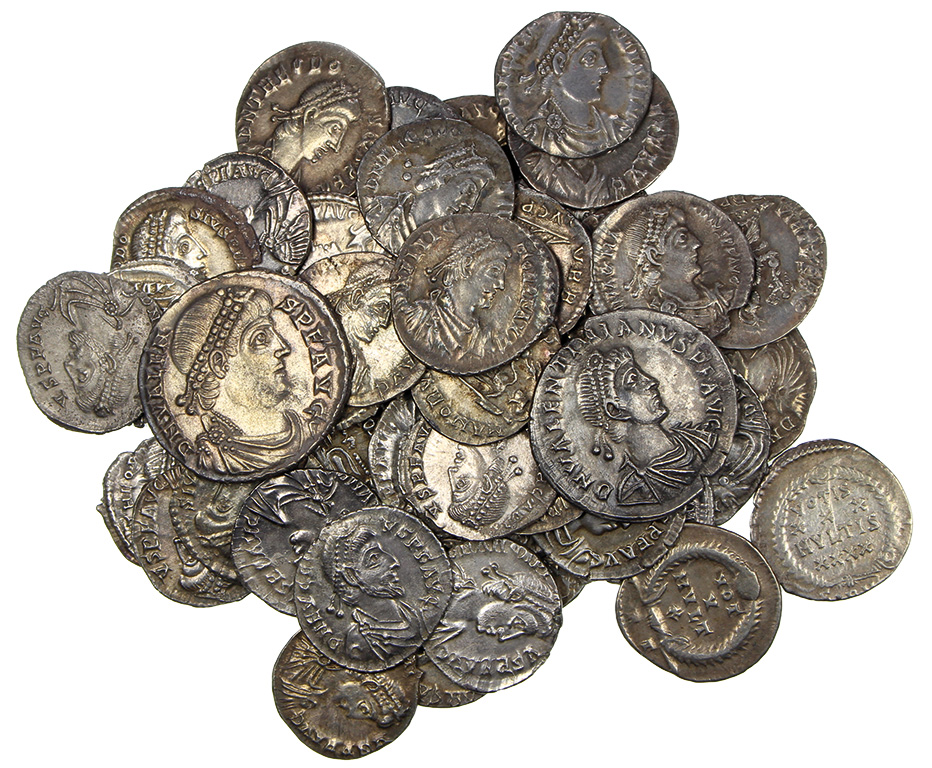
A total of 160 coins were recovered, some fragmentary – though most were complete and preserved in extremely fine condition. The earliest piece in the hoard had been struck for the Emperor Constans in or shortly after AD 342, and the latest in or shortly after AD 402 for Arcadius. There was no sign of a container as is usual with finds like this leaving the tantalizing question of whether this still lay deeper in the ground waiting to be found. Subsequent investigation of the site has confirmed that what we see here was the majority of the original deposit with only a few further individual coins located. This gives us what numismatists and archaeologists call a Terminus Post Quem – ‘date after which’. The hoard cannot have been buried before the date of its latest coin, and thus we can say with certainty that the Pewsey find must have been buried at least in or after AD 402, coinciding with the withdrawal of Roman support from Britain.

THE WIDER ARCHAEOLOGICAL CONTEXT

Archaeological study of the wider Vale of Pewsey during the 4th and early 5th centuries suggests that the area was primarily given over to arable farming, with scattered rural settlements and several potential villa sites (including the solidly identified example at Stanchester) occurring across the landscape.

This was a fertile landscape, one which likely served as a major component of grain production both locally and as a continental export. If north Africa and Egypt were the breadbasket of Rome, then Wiltshire was probably one of the major producers for Britannia. However, despite its agricultural potential – things were beginning to change. The fourth century marks the beginning of rural decline – many villas ceased in their roles as luxury country estates, some being abandoned and others converted for industrial purposes.

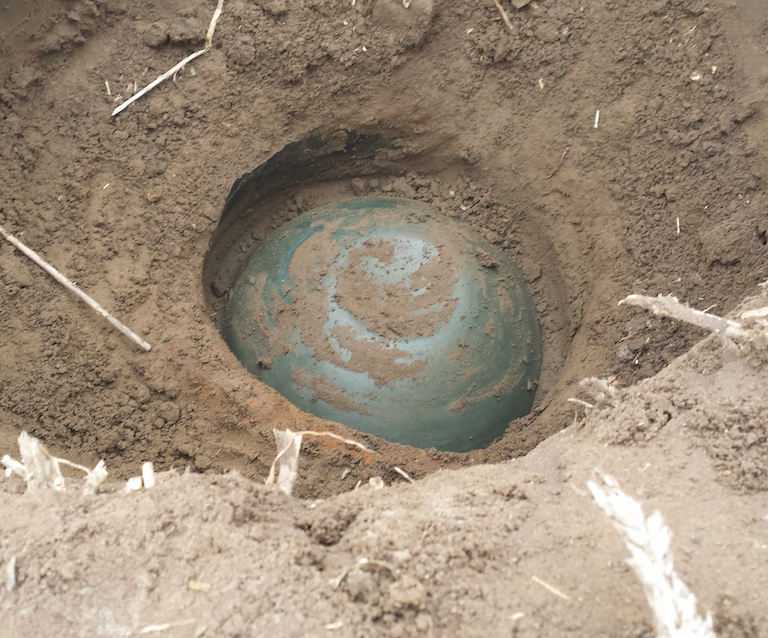
Intriguingly, this hoard was discovered in the same field as the ‘other’ Vale of Pewsey hoard found by the same group of detectorists back in 2014 – a group of copper-alloy vessels deposited somewhere between c. AD 340 and 402. In a coup for the scientific community, these provided a wealth of environmental data due to the preservation of plant material utilised as packing, which was stuffed inside the vessels before they were deposited. It seems unlikely that this placement of the two hoards in broadly the same area is accidental, though what specific landscape features exactly drew people to making these two deposits will probably forever remain unknown.

Additionally, it is perhaps also worth pointing out at this juncture that the Stanchester hoard of c. 1200 late Roman silver coins, buried near the villa of the same name in the parish of Wilcot, Wiltshire, was located only a short walk from the ‘other’ Wilcot hoard. In striking similarity to the Pewsey finds, this consisted of an assemblage of Roman copper alloy vessels buried in the late 4th or early 5th centuries. It is tempting to speculate that from a ‘ritual’ point of view, the dual deposition of coin and vessel hoards in this region may have had some special significance to its Romano- British inhabitants during the later 4th and 5th centuries.

Copper-alloy vessel hoard

LATE ROMAN COINAGE IN BRITAIN

A trimetallic coinage comprising bronze, silver and gold circulated in Britain during the later 4th century. However, the bronze issues, small denominations that modern numismatists term nummi (sing. nummus), predominate. This is likely because they represented a useful ‘token’ coinage if nothing else, highly suitable for use in daily transactions but quite rarely ending up in hoards themselves due to their low value.

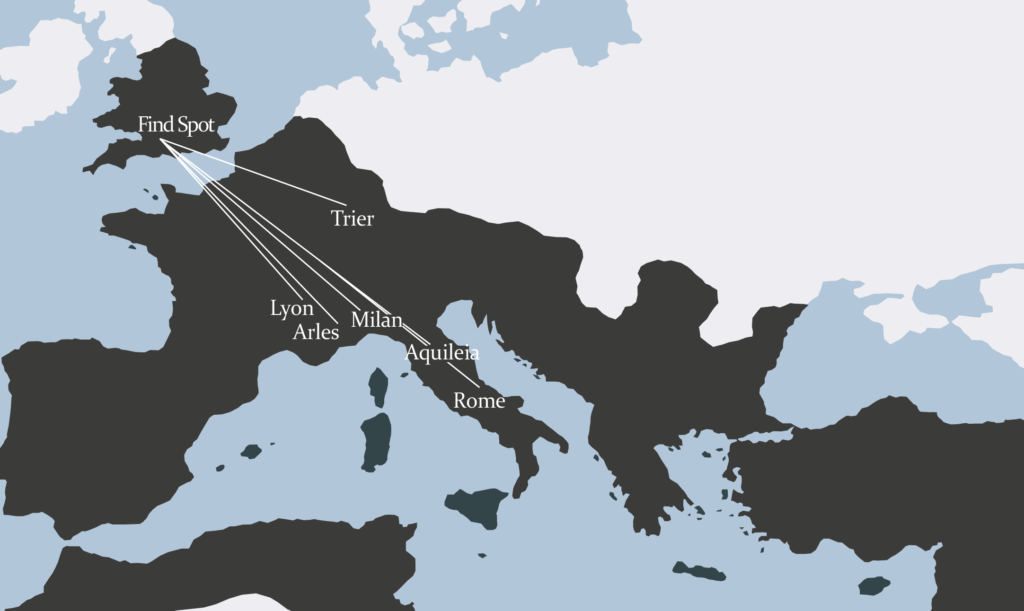
The supply of Roman coinage to the province was reduced substantially after AD 402, and almost totally after the death of the emperor Arcadius in AD 408. While coin finds dating after AD 408 are encountered in Britain, they are extremely rare by comparison – often found on a scattered singular basis with a few concentrated in hoards. These finds attest to a degree of continued contact, human movement and trade between Britain and the Continent after the ‘official’ Roman withdrawal from Britain in AD 410. However, in stark contrast to before, coin was not literally ‘flowing’ across the Channel from the principal late Roman European mints at Treveri (Trier, Germany), Lugdunum (Lyon, France) and Mediolanum (Milan, Italy).

Towards the end of the 5th century, coinage (particularly that of precious metal) began to circulate for longer and longer as the supply became diminished – a trend which we can see quite clearly when analysing coins found in hoards. For example, the famous Hoxne (Suffolk) hoard of silver/ gold coins and objects was deposited shortly after AD 408 – but almost half of the coins within it were over twenty years old when it was buried. As an example of a more extreme example of this practice, the Patching (West Sussex) hoard of coins and jewellery was deposited sometime after 461-465 but contained clipped siliquae that were almost a century old.

As we shall see in due course, this cessation in production and importation of coin to Britain marked a sea change in which the province, standing at a crossroads on its relationship with the Roman empire, navigated itself both culturally and economically in the years after its schism with the Imperial administration.

HOARDING IN LATE ROMAN BRITAIN I: THE ‘STRESS’ MODEL

It was previously thought that most of the late Roman metal hoards were buried between approximately AD 390 and 410 as a direct response to two known social pressures. Firstly, attacks on Britain by roving bands of Saxon, Frisian and Danish pirates striking across the North Sea.

Secondly, the winding down of Roman military presence in Britain prior to the ‘official’ withdrawal of troops as ordered by the emperor Honorius in AD 410. In his work De Excidio et Conquestu Britanniae (‘on the ruin and conquest of Britain’), written in the late 5th or early 6th century, the British monk Gildas presents a somewhat horrifying picture:

From a first viewing, this scenario seems logical – representing what academic Peter Guest called the ‘stress’ or ‘emergency’ mode of hoarding in his definitive paper on hoarding in Roman Britain during the 5th century. It was thought that the breakdown of Roman authority created civil strife – the fear of violence and civil uncertainty leading to people burying their material wealth out of concern for its safety. That many of these hoards were never recovered was interpreted as additional evidence which bolstered this argument. Evidently, their owners were killed during said episodes of violence, or carried off into slavery by the marauding raiders who were able to operate with impunity now conventional military forces had left the province.

But the above supposition oversimplifies the model – and it must be noted that Gildas’ reliability is highly questionable. The ‘end’ of Roman Britain was not a cataclysmic event where cities literally collapsed into dust. The inhabitants of what had been Britannia did not throw off all trappings of Roman life, running to eke out a brutal existence in the hills as marauding Saxons raided across the North Sea. Archaeology and study of numismatics have also shown that it is not really correct to see AD 410 as a hard ‘end’ – but rather a complex period of transition between two very different periods in history.

HOARDING IN LATE ROMAN BRITAIN II:
ALTERNATIVE PERSPECTIVES

The so-called ‘stress’ model fails to take account of some fairly important evidence. Perhaps the most obvious clue lies in the fact that such apparently profligate hoarding of precious metal during this period is a feature virtually unique to Britain, with very few hoards late 4th or 5th century hoards known from other parts of the Empire. This factor would suggest that the predominant reason for doing this was not due to attacks by rampaging barbarians.

In AD 405, the Gothic King Radagaisus crossed the Danube with his forces and plundered his way to Italy until his defeat in AD 406. In the same year a confederation of Alans, Vandals and Suebi crossed the Rhine – causing havoc in Gaul. Worst of all, the Gothic King Alaric invaded Italy twice, in AD 408 and AD 410 – sacking Rome itself during the latter event.

Yet importantly, for all the strife and anxiety these events must have caused, there is no visible explosion in the hoarding of wealth.

Comparable parallels for this sort of behaviour can be found in locations such as Romania, Denmark, Poland and Hungary, hoards of Roman silver and gold coinage (in addition to objects, some hacked up into bullion) are quite frequently found – a trend comparable to that in Britain. This kind of hoarding behaviour in the late Roman world is in itself very ‘un-Roman’ – especially in regards to objects (rather than coins) of precious metal. A highly unusual system seems to have existed in the time of the late empire, with valuable items of plate or jewellery apparently part of a complex social system of gift giving controlled largely by the Imperial household or its local administrations. Objects were intended to circulate as ‘currency’ within this system – not to be stashed away and hidden by their owners. Such a system created social obligations, reinforced pre-existing relationships and indebted the receiver of the gift to the giver – an important incentivising factor in an era where palace coups, treason, corruption and general incompetence were frequent occurrences. That the opposite seems to have occurred in Britain during this period is highly atypical and implies that for many people in the province, what was being buried had greater value or symbolic significance through being placed into the ground than actively being used in any sort of functioning economy.

COINS IN THE VALE OF PEWSEY HOARD

DENOMINATIONS

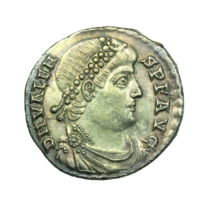
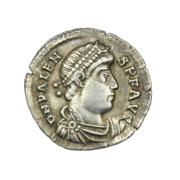
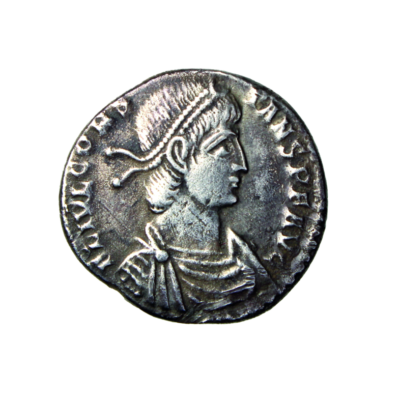
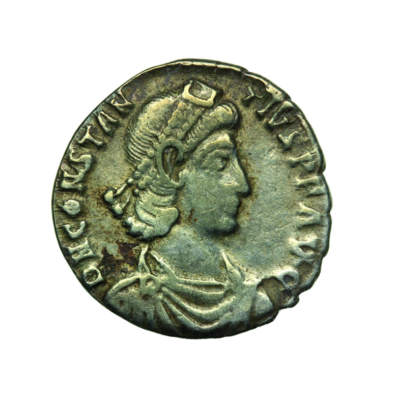
The Pewsey hoard contained two denominations of late Roman silver coin – the small siliqua (pl. siliquae), and the larger miliarense (pl. miliarenses). It must be noted at this juncture that these are names which have been applied to these coins in the modern period based on some hints in ancient sources.

The 6th and early 7th century scholar Isidore of Seville tells us that the siliqua was a unit of measurement used in the late Roman Empire – reflecting approximately 2g in weight and being equivalent in value to 1/24 of a gold solidus (the name of a large gold coin). This name was thus applied to the small (c. 17-18mm in diameter) silver coins struck across the late Empire from the early decades of the 4th century right up until the 6th century in the East. Siliquae are aesthetically quite beautiful, though many possess striking cracks. This feature which reveals their overly fast production through insufficient annealing of blanks prior to striking. In addition to this, many of those that made their way to Britain circulated for very long periods of time and were frequently clipped down heavily.

Copies of siliquae are also not uncommon to encounter, these being of variable metal and quality – though some are quite convincing. While perhaps not as commonly found in Britain as denarii of the 1st and 2nd centuries, siliquae are still relatively plentiful site finds.

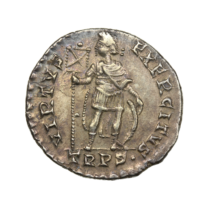
The PAS, to give a measure of scale, has almost 2500 records for individual siliquae on their database. These are primarily concentrated in Wiltshire, Norfolk, Lincolnshire and East Yorkshire. By contrast, miliarenses are a very different kettle of fish. Large and impressive pieces of around 24mm diameter, these represent the very peak in skills of the late Roman die-cutter – perhaps second in quality only to some of the extremely rare silver and gold medallions of special issue which are occasionally found. Typically weighing in between c. 4.3 and 4.9g, one could make the argument that they represent a sort of ‘double siliqua’ – though the impressive artistry and reverse designs has led some to theorise that these were probably intended as presentation pieces for members of the military rather than general circulation.

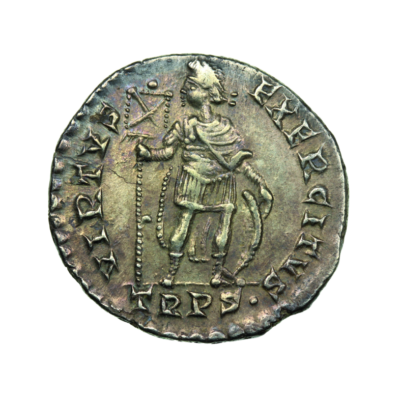
Indeed, many miliarenses display an image of the Emperor in military dress – accompanied by the inscription VIRTVS EXERCITVS – ‘to the courage of the army’. How better to ensure the motivation and continued loyalty of soldiers than by the distribution of silver bonuses and rewards to supplement their monthly salaries at impressive, lavish ceremonies? Silver miliarense (top) compared to silver siliqua Actual Size 24mm and 18mm Certainly, in light of this fact it is undoubtedly tempting to consider whether many of the British late Roman hoards which contain these coins were deposits made by members of the military.

Valens Inside Cover Front
IMAGE 5 copy
IMAGE 5
IMAGE 3

Silver miliarense (left) compared to silver siliqua
Actual Size 24mm and 18mm

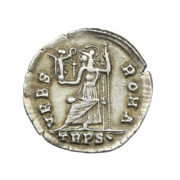
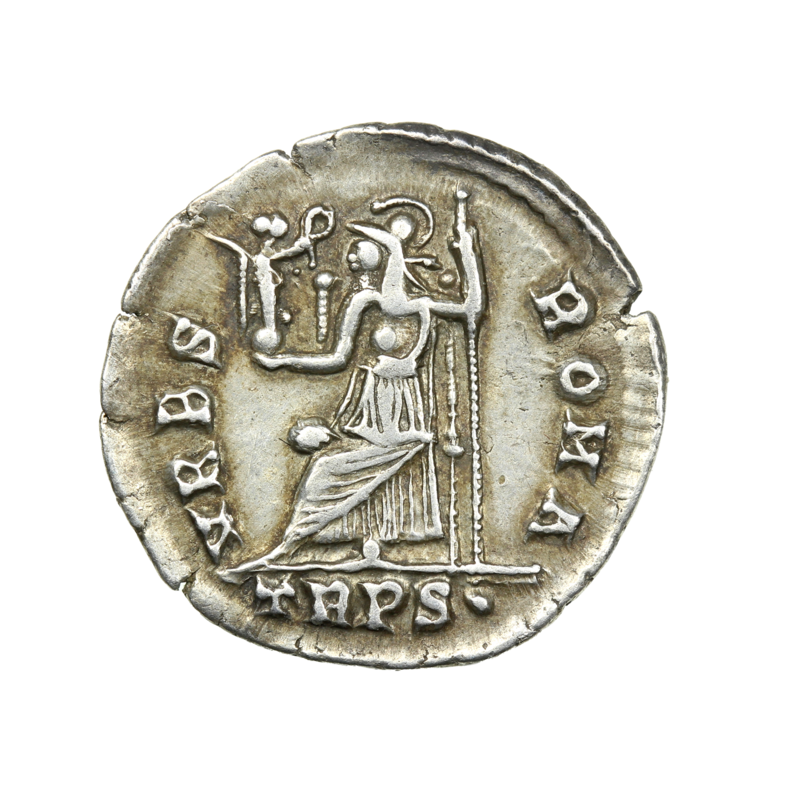
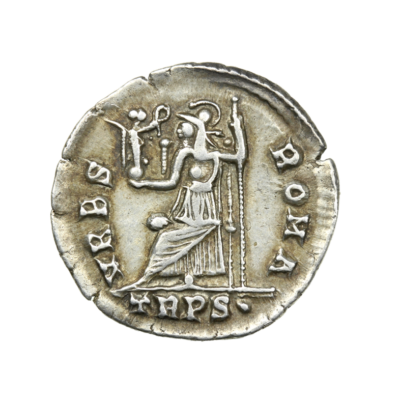
‘TRPS’ Mintmark shown in exergue

MINTS

Like many other empires, states and general issuers of money throughout history – the Romans invested huge importance into quality control. Although for much of Rome’s earlier history, Imperial coinage had been issued mostly from the central mint at Rome, by the time of the late empire money was being made at a variety of different regional mints.

Such a complex system required careful management, and a standardised system of symbols was devised which enabled the source of coins to be determined accurately. Numismatists refer to these symbols as ‘mintmarks’. In the 4th century, mintmarks on Roman coins usually consist a series of letters sited under the exurgal line of its reverse face. These usually identify the mint itself, while further marks in the reverse fields indicate the specific officina (workshop) responsible for striking said coins. The symbols displayed upon each coin enabled it to be traced back to a manufacturing point, which was not only critical for keeping track of bullion use, checking quotas and tracking the number of pieces issued – but also played a key role in ensuring the coin was of good quality.

These letter-combinations are abbreviations often 3-5 letters long. Typically, they include anywhere between one and four letters denoting the mint signature, usually combined variously with the letters ‘M/PS’ or ‘P’.

Historically, these were variously interpreted as standing for Moneta/ Pecunia Sacra (sacred money/coin) or just Pecunia (money). Use of the former reveals the importance placed upon good coining by the Roman state, affording it a semi-religious status. Under the above interpretation – the mintmark ‘MDPS’ on a siliqua of Honorius would inform us that the coin was minted at Mediolanum – modern Milan, the expanded reading of this being Mediolanum Pecunia(rum) Sacra -literally, ‘sacred money of Mediolanum’.

However, a more likely alternative suggestion has been suggested more recently. On silver coins, the abbreviation ‘PS’ is probably intended to signify the word pulsulatum – indicating that the coin was manufactured from pure silver. Nevertheless, both interpretations attest to the same end-goal, the desire to keep the process of moneying wholly accountable to its administrators and fully traceable back to its point of origin.

The Vale of Pewsey hoard contains coins from nine of the principal mints sited across the breadth of the late empire, a testament to the sheer scale of Roman money-making during this period in history. One coin in the hoard, struck during the reign of Julian II, originates from the mint of Aquileia, some 1750km away from Wiltshire, quite some journey without an aeroplane!

Mints Represented

Coins

Trier

105

Arles

2

Milan

17

Lyon

14

Rome

6

Aquileia

2

Other

4

Uncertain

10

Total

160

REVERSE TYPES

Although one could say that Roman coinage (and indeed, ancient coinage in general) is largely defined by its variability – this statement doesn’t quite hold true for the 4th century. By this period, reverse designs on coins of gold, silver and bronze had contracted heavily, depicting a smaller number of selected ‘themes’. This contrasts starkly with the days of the 1st or 2nd century, when there are quite literally hundreds of reverse designs for the denarii of Hadrian, Trajan or Antoninus Pius to name but a few. Below, we present and analyse reverse designs present on the siliquae and singular miliarense found in the Colkirk hoard.

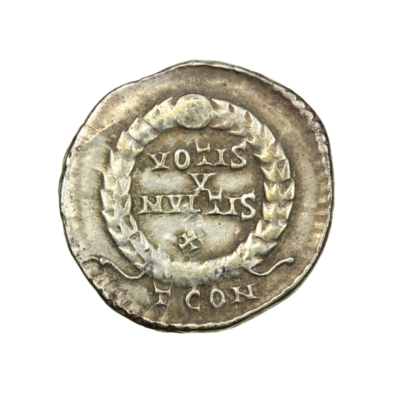
Votive/Vows for service
These issues refer to the vows made by emperors either in undertaking or continuing their service to the empire every five years or so, as well as celebrating their anniversaries of rule.

Personification of Rome
Roma seated on a throne in military dress with a spear in one hand, usually a globe in the other.

Personification of Victory
Depicted winged and wearing a long, flowing mantle – she holds a laurel wreath and palm frond. These two accessories symbolise triumph, and are synonymous with her role.

The Emperor in military attire (miliarense)
Emperor standing dressed as a soldier, holding a small military standard known as a labarum in his right hand. His left-hand rests on a shield which sits on the ground.

EMPERORS PRESENT

No fewer than thirteen emperors who ruled over the later Roman Empire are represented in the hoard, dating from the mid-4th to early 5th centuries AD This is typical of similar hoards from this period, almost always ending with coins of the emperor Honorius.

Constans (AD 337-350)

1

Constantius II (AD 337-361)

6

Julian (AD 360-363)

4

Valentinian I (AD 364-375)

3

Valens (AD 364-378)

19

Gratian (AD 367-383)

16

Valentinian II (AD 375-392)

10

Theodosius I ‘The Great’ (AD 379-395)

15

Magnus Maximus (AD 383-388)

18

Flavius Victor (c.AD 383-388)

3

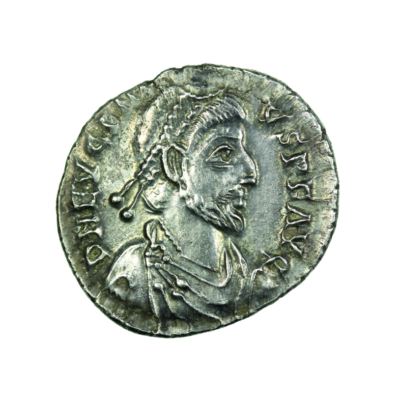
Eugenius (AD 392-394)

15

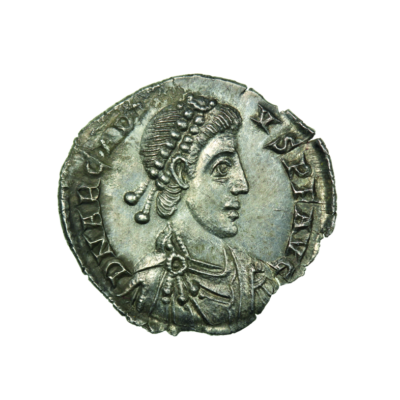
Arcadius (AD 383-408)

23

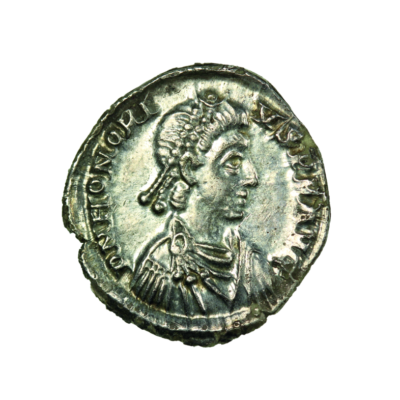
Honorius (AD 393-423)

9

Uncertain

18

Total

160

By the time the Vale of Pewsey hoard was buried in or after AD 402, the Roman empire had been ruled over by emperors for over four centuries. However, the amount of change that had been wrought upon that institution since the reign of the first emperor, Augustus, was extreme indeed.

The rule of the emperor was now supplemented by the ever-growing imperial household and its numerous administrative roles. By contrast, the power of the Roman senate was greatly diminished – it performed some administrative functions within the city of Rome itself, but beyond this had little input into broader governance.

Perhaps most significantly, the empire had been administratively split by Diocletian in the late 3rd century – each half (west and east) was ruled over by a separate emperor and his deputy-in-waiting. This was called the ‘tetrarchic’ system (rule of four). Under this system, the senior emperors bore the title of Augustus, while those in the junior or deputy position were referred to as Caesar. This system existed (and worked reasonably well) for the first quarter of the 4th century until AD 324, when Constantine I took back sole rule after being betrayed by his co-emperor, Licinius, who had taken up arms against him.

To confuse matters further, on Constantine’s death – the control of the empire was once again split, this time between his three sons. This arrangement of co-ruling would last in various states until the death of the emperor Theodosius I in AD 395, whereupon the Roman world formally fractured into two separate entities. In contrast to before, this represented more than a simple administrative change – but was as much concerned with issues of identity as anything else. The west and the east, with the former speaking mostly Latin and the latter Greek, were culturally (and geographically) worlds away from each other.

This arrangement would exist until AD 476, when the western Roman empire effectively ceased to exist after the deposition of its last emperor (ironically named Romulus Augustus, after Romulus – the legendary founder of Rome), by the Gothic general Odoacer. The eastern Roman empire continued on, often referred to in the modern era as the Byzantine empire, until 1453 – when Constantinople was finally conquered by the Ottomans.

Constans

CONSTANS (AD 337-350)

Constans was a member of the so-called ‘House of Constantine’ or Constantinian dynasty – a series of emperors ruling during the first half of the fourth century who were all the progeny of Constantine I ‘The Great’. On the death of Constantine, who had undertaken sole rule of the entire Roman empire, he left its administration to his three sons: Constans, Constantine II and Constantius II. Its rule would be divided between them, with Constans taking charge in the provinces of Italy, Illyricum (an area encompassing modern day Croatia, Slovenia, Albania and Bosnia) and Africa. He faced a significant challenge early in his reign from Constantine II, who invaded Italy in AD 340 after disputes concerning the exact division of territories in North Africa. However, Constantine was killed near Aquilea during an ambush, and Constans was thus able to annex his brother’s territories in Gaul, Britain and Spain. A dynamic figure, he campaigned across the Rhine in the 340’s and also visited Britain to subdue a Pictish incursion across the frontier. He was betrayed by his general Magnentius in AD 350, being killed in battle shortly afterwards. A successful propaganda campaign by Magnentius resulted in late Roman historians vilifying him for alleged homosexuality, though ironically Constans had upheld several edicts issued through his reign which prohibited the practice.

Constantius II

CONSTANTIUS II (AD 337-361)

While his brothers Constans and Constantine II took control of most territories in the western portion of the Roman empire, Constantius spent most of his reign governing in Greece, Egypt, Asia Minor and the Near East. This had long been a troublesome area: aggressive tribal confederations such as the Alemanni, Quadi and Sarmatae threatened Greece and Thrace, while border areas such as Cappacadocia and Syria were constantly at the mercy of the Sassanian Empire – an aggressive, expansionist state born out of the ashes of its ancestor, the Parthian Empire. Constantius waged a series of costly wars against the Sassanids which smouldered for most of his reign; though the death of his brother Constans at the hands of rebel general Magnentius in AD 350 drew his attention back west. Defeating Magnentius and his brother Decentius in a campaign that lasted until AD 353, Constantius eventually took sole control of the empire. Almost as famous for his edicts against pagan practices and anti-Jewish laws as he is for his military vigour, Constantius returned to the east

Julian II

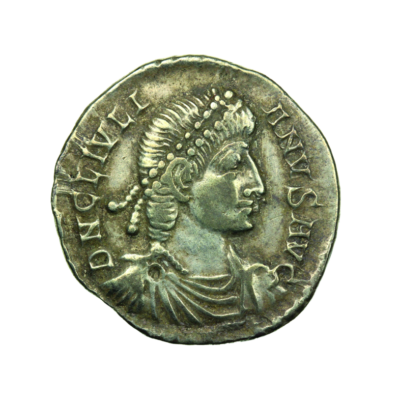
JULIAN (AD 360-363)

A nephew of Constantine the Great, many of his immediate family were executed in the great purge undertaken by Constantine’s sons upon his death in AD 337 – a massacre intended to rid them of as many potential rivals as possible. Having spent much of his early life in Constantinople, Julian was heavily influenced by its multicultural, diverse society. A cultured man of letters, many of his religious and philosophical writings have come down to us thanks to the scholarship of Medieval and Renaissance chroniclers. Though brought up as a Christian, his experiences in the east lead him to convert to paganism – and indeed he was the last pagan emperor of Rome. In AD 355, he was appointed to govern Gaul by Constantius II – and duly busied himself with administering the province as well as leading punitive attacks across the Rhine border. When Constantius attempted to requisition troops from Julian’s Gallic command in preparation for fresh conflict with the Sassanians, they responded by revolting and proclaiming Julian emperor while stationed at Lutetia (modern day Paris). Julian duly marched south and Constantius began to return from the east in order to confront him, though true civil war was averted due to his sudden death in November of AD 360. Entering Constantinople in AD 361, Julian was acclaimed as sole emperor – focusing his initial attentions on overhauling Constantius’ administration and issuing edicts concerning the freedom of worship. In AD 363 he set out from Antioch in a campaign against the Sassanids, reaching their capital of Ctesiphon but failing to take the city. During the withdrawal, Julian was wounded and died some days later – being buried near the city of Tarsus.

Valentinian I

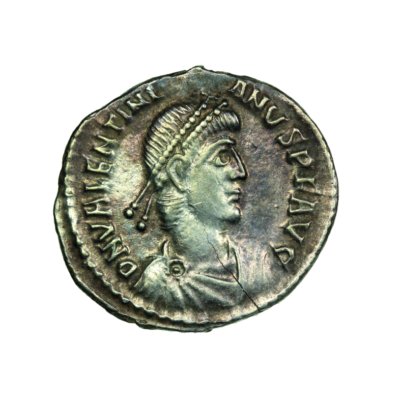
VALENTINIAN I (AD 364-375)

In the aftermath of Julian’s death on campaign, the purple was assumed by a military officer called Jovianus – who was forced to make many concessions of territory recently won from the Sassanids in order to save the invading Roman army from total annihilation. Jovianus would die after just eight months rule and before he had time to reach Constantinople. A council at the city of Nicaea resulted in the selection of Valentinian, then a senior military officer in the Scholae Palatina (an elite unit of the Imperial bodyguard). On becoming emperor, Valentinian raised his own brother Valens as co-emperor to rule over the eastern portion of the empire. The founder of the so-called Valentinianic dynasty, much like many of his predecessors, Valentinian spent a good deal of his reign campaigning across the Rhine against the Alamanni and Quadi. Though largely successful, these campaigns came at a high cost to his own forces. In AD 367-8, the so-called ‘great conspiracy’ occurred in Britain, as described by the 4th century commentator Ammianus Marcellinus. An apparently coordinated effort between the Picts, Hibernians and Saxons, coupled with traitorous behaviour by some of the units garrisoning Britain, resulted in much instability in the province – and it was only the intervention of Valentinian’s general Theodosius that prevented its total ruin – who rebuilt fortifications, replaced garrisons and generally restored the province. In AD 375, Valentinian died while on campaign against the Quadi in Hungary, apparently suffering an apoplectic fit of rage while treating with contemptuous barbarian envoys. He was succeeded by his son Gratian, who took up rule over the western provinces of the empire at the age of just sixteen. His second son, Valentinian (who would become Valentinian II) nominally coruled alongside Gratian, though his input was minimal due to his only being four years old at the death of his father.

Valens

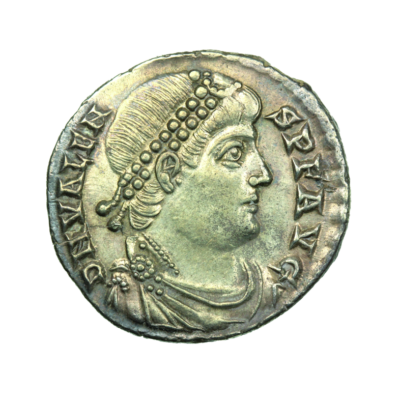
VALENS (AD 364-378)

After being raised to the purple by his brother, Valens spent much of his time ruling the eastern provinces of the empire from Constantinople. This was an unenviable task, as he was required to deal very quickly with both Sassanid incursions into Armenia and a rebellion against his own rule by the usurper emperor Procopius – one of the now deceased Julian’s relatives. As if he didn’t have enough to deal with, while preoccupied with Procopius the Goths struck into Thrace – plundering and pillaging. Unable to deal with them militarily, Valens was forced to make an unfavourable peace in exchange for their departure. Despite his best efforts, the situation in the east continued to deteriorate through most of his reign, with revolts in Cilicia and Palestine during the 370’s only serving as distractions from the most pressing threats further afield. In AD 376, a new menace appeared on the horizon in the form of a mass migration of the Gothic peoples – lead by their king, Fritigern.

However, the Goths themselves were fleeing an even worse nightmare, the invasion of their homelands by the steppe-dwelling nomadic Huns. Though Valens accepted the Goth’s pleas to settle in safety within the Danube border, major abuses of power appear to have taken place towards the refugees – with confiscations of weapons and property, the separation of families, withholding of food and forced recruitment of younger men into the Roman army all recorded as taking place. Left in an impossible position, the Goths took up arms against the Romans. Fighting an initial series of inconclusive skirmishes, Valens made the catastrophic decision to engage the Goths with heavily depleted forces and ahead of the arrival of reinforcements sent by his nephew, Gratian. The resulting engagement at Adrianople on August the 9th, AD 378, resulted in a total rout of the Roman forces by the Goths. Ancient estimates, though likely inflated, suggest anywhere between 10-20,000 Romans died including many experienced officers, a huge portion of the manpower available to the eastern Empire being wiped out in the course of just one day. Valens died somewhere on the battlefield, his body was never found.

Gratian

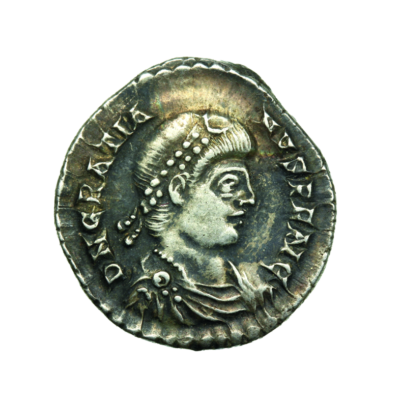
GRATIAN (AD 367-383)

The elder son of Valentinian I, Gratian was groomed for the emperorship from an early age. Accompanying his father on numerous military campaigns across the Rhine, he was raised to the rank of Augustus at eight years old.

Taking control of the western half of the empire at the age of sixteen in AD 375, he faced initial challenges from some generals as well as the mother of his halfbrother, Justina, who insisted her son (the future emperor Valentinian II) be raised to the rank of co-emperor despite being only four years old. Eventually succeeding in maintaining his position as senior emperor, Gratian set about ruling – though his early reign was marred by the aftermath of Adrianople and ensuing instability across the empire’s borders caused by the drastic reduction in manpower. Arguably, Gratian may well have inadvertently saved the empire when he ratified the appointment of a highly motivated and competent general, Theodosius, to be his uncle Valens’ successor in the east. Theodosius himself would in turn go on to become one of the most effective Roman emperors of the later 4th century.

Gratian spent much of his reign as his predecessors had – fighting against barbarian incursions on the Rhine frontier. However, he also involved himself in religious affairs. A Christian through and through, writers record Gratian’s many acts against traditional institutions of the pagan pantheon in Rome, such as the confiscation of all non-Christian shrines or temples alongside their revenues, while defunding cults and the sacred office of the Vestal Virgins. In AD 380 he co-ratified the Edict of Thessalonica, which upheld the orthodoxy of Nicene Christianity and deemed other Christian sects to be heretical.

However, his religious reforms were not long lasting. In AD 383, while campaigning again against the Alemanni, Gratian heard bad news from Britain. The general Magnus Maximus, who had helped re-conquer the province during the crisis of AD 367, had rebelled and declared himself emperor before departing for Gaul at the head of his extensive force. Gratian confronted Maximus, but his troops deserted him. Forced to flee, he was quickly isolated, captured and killed on Maximus’ orders.

Valentinian II(1)

VALENTINIAN II (AD 375-392)

Born in AD 371, Valentinian II was raised to the emperorship in AD 375 when his father, Valentinian I, died. A pawn of his mother and certain high ranking army officers, Valentinian II was only ever intended to be a figurehead ‘co-ruler’ to his older half-brother Gratian. However, the late 5th century historian Zosimus tells us that Valentinian did have some genuine responsibilities, helping (though probably in minor ways) to administer the provinces of North Africa, Illyricum and Italy.

Though largely sidelined by his halfbrother, Gratian’s death at the hands of Magnus Maximus in AD 383 forced him to treat with the usurper in order to prevent his own death.

Though Maximus was duly recognised as a legitimate co-emperor by Valentinian II and Theodosius, he nonetheless invaded Italy in AD 387 and forced the young emperor to flee to Greece.

Returning to the west after Maximus’ eventual defeat, Valentinian is recorded as struggling to impose authority upon many of the wayward military officers who had become too used to controlling him before he came to adulthood, particularly the general Arbogast – who is said to have humiliated Valentinian’s status by refusing his orders publicly. He was found dead in AD 392, hanged in his own room – though whether this was suicide or involved foul play is anybody’s guess.

Theodosius I

THEODOSIUS I ‘THE GREAT’ (AD 379-395)

Theodosius, an experienced soldier of some renown, was raised to imperial office by Gratian in AD 379 following the death of his uncle, Valens. His father, also (confusingly) called Theodosius, had been instrumental in retaking Britain for Valentinian I during the troubles of AD 367.

Taking charge after the catastrophe of Adrianople, Theodosius’ domestic policies were critical in ensuring regional stability. Knowing that defeating the Goths was impossible, he instead made friends of them – allowing them to settle in the empire as allies with the privilege of self-governance. This came with the caveat of providing units for military service, allowing the decimated eastern army to recoup some of its losses. Despite this, he was still limited militarily – as shown by his decision to accept (though temporarily) the rule of Magnus Maximus even after his rebellion and murder of Gratian in AD 383. However, when Maximus attacked again in AD 387 and forced Valentinian II to flee, he finally had the means to act accordingly – defeating the usurper at the Battle of Poetivo (near modern Sisak, Croatia) in AD 388 and capturing him alive.

Though he brutally executed both Maximus and his infant son, the promise of power was too alluring for some. In AD 394, he was forced again into civil war – this time against the rebel Eugenius, an official in the household of Valentinian II who had been proclaimed emperor in the west following his master’s death. Though ultimately victorious, this event would be one of Theodosius’ last achievements, the emperor dying the following year. He was the last ruler of the united empire, it fracturing into east and west after his passing. However, he did found a dynasty of sorts – his descendants, with varying degrees of competence, would variously rule over both halves of the empire for the next 60 years.

Magnus Maximus

MAGNUS MAXIMUS (AD 383-388)

Maximus, another soldier emperor who usurped the throne from Gratian in AD 383, is a figure whose story is intrinsically entwined with Britain. He appears as a semi-mythical figure in both British and Welsh folklore – typecast as a mighty ruler who marries local princesses, begetting a long-lasting dynasty and even voluntarily handing back power to local rulers before departing the province.

Sometimes, the line between reality and myth becomes highly blurred. For example, his name purportedly appeared alongside that of another ‘legendary’ British ruler – Vortigern – on a 9th century stone monument now in Denbighshire, Wales, which is referred to as the Pillar of Eliseg. The purpose of this monument was to detail the ancestry of the Kings of Powys – so clearly, if this piece of evidence is to be trusted, Maximus (or ‘Macsen’ as he appears in Welsh legends) was very much seen as a key figure in Britain’s history. However, the inscription on this monument is now illegible and was only last recorded in the 18th century – so it is technically possible that some of it was either abbreviated, incorrectly transcribed or simply made up by antiquarians.

Whereas much of the above is difficult to corroborate or downright incorrect – there are some things we do know. Maximus was probably present in Britain under Count Theodosius during the troubles of AD 367, and it appears that he was present in the province from then onwards – likely contributing significantly to a major victory over the Picts in AD 380.

Hailed as emperor by his troops in AD 383, he made a bid for power and set sail for Gaul with large numbers of troops – though given that archaeological remains and coin evidence from Hadrian’s wall indicates a continuing Roman presence there, the claim by the 9th century monk Nennius in his Historia Brittonum that Maximus quite literally emptied the province of troops to achieve his goals is clearly an exaggeration. Landing on the Continent, Maximus quickly routed Gratian’s forces and killed the young emperor – using his military might to force an unfavourable settlement with Valentinian II and Theodosius I.

Though acclaimed emperor in the west, Maximus evidently had his eyes on the entire prize – and in AD 387 he attacked Valentinian II, forcing the emperor from his base at Milan and sending him fleeing. This was too much even for Theodosius, and he defeated Maximus in several key engagements through AD 387-388 before capturing him and his infant son Flavius near Aquilea.

Though he threw himself on Theodosius’ mercy, this was to no avail – Maximus was duly executed the same year, his wife and daughters apparently were separated and married off to eligible nobles in far flung corners of the empire.

Flavius Victor

FLAVIUS VICTOR (C. AD 387-388)

The infant son of Magnus Maximus, Flavius was raised to co-emperor alongside his father when he vanquished Gratian – though his date of birth is not known. Coins were issued in his name at a number of mints, though they are noticeably rarer than those of his father. Captured in Gaul following Maximus’ defeat by Theodosius, Flavius survived him – but only by a few weeks. Unlike his father, Flavius’ death was far slower and decidedly more brutal – being strangled to death by one of Theodosius’ generals, Arbogastes.

Eugenius

EUGENIUS (AD 392-394)

Eugenius was an official in the Imperial court of Valentinian II and had previously been a teacher of rhetoric, but on the latter’s untimely death in AD 392 he seems to have taken advantage of the ensuing power vacuum in the west to declare himself emperor. He was effectively sponsored in his efforts by the General Arbogastes, who probably himself had some sort of hand in Valentinian II’s demise. Though Eugenius attempted to make his accession to the emperorship appear legitimate by sending envoys to Theodosius, these were received coldly and sent away quickly. Nominally a Christian, Eugenius’ reign is unusual in that he was apparently persuaded to renovate many pagan buildings in Rome and sponsored a number of previously defunded institutions – the temple of Venus and Roma near the Forum Romanum was even re-dedicated during this period of apparent pagan revival.

In AD 393 Theodosius elevated his own son Honorius to the rank of Augustus in the west – effectively declaring Eugenius’ rule to be non-valid as a result. Entering into open warfare, Eugenius and Arbogastes fought Theodosius’ forces at the Battle of the Frigidus (near the modern day town of Vipava on the Italian/Slovenian border), where they were eventually overcome. Historians disagree on Eugenius’ ultimate fate – some say he was killed during the battle, others that he was captured and publicly executed like Magnus Maximus had been.

Arcadius

ARCADIUS (AD 383-408)

Arcadius was the elder son of Theodosius the Great, being raised to the co-emperorship at the age of just six. Though his father was extremely capable, Arcadius lacked his long years of military experience, and thus was rather vulnerable to the machinations of powerful officials within the Imperial inner circle. After the death of his father in AD 395, the empire split permanently in two – with Arcadius ruling in the east from Constantinople and his brother Honorius ruling in the west – variously out of Milan and Ravenna.

He was heavily influenced in his early reign by two key figures who both sought to gain influence over him – Rufinus, the praetorian prefect of the eastern empire, and an ex-slave named Eutropius, who rose from humble beginnings as a court eunuch to become first a general and then a consul in his own right. It was thanks to the latter that his marriage to the noblewoman Aelia Eudoxia was brokered, daughter of an important and influential deceased western Roman military official. However, the back-andforth nature of power plays in Arcadius’ court is perhaps revealed by the fact that Rufinus himself had originally hoped to marry off his daughter to the emperor – thus becoming his father-in-law and by default, politically unassailable.

Not a soldier by training, Arcadius seems to have left most of the fighting to his competent generals and focused his attentions in other areas – specifically the ongoing management of religious conflict between Christians and pagans. The so-called ‘Theodosian Code’, a record of laws and ordinances compiled by Theodosius and his successors during the late 4th and early 5th centuries, records a series of anti-pagan edicts passed by Arcadius in AD 399, including an order that pagan temples in the countryside should be pulled down to force worship in towns and cities, where it could be kept firmly under the watchful gaze of authorities. Historians have largely found it difficult to assess Arcadius’ character or achievements accurately given that most sources describe the various individuals who manipulated him and sought to use him for their own ends. The last of these, the praetorian prefect Anthemius, was seemingly vaguely competent – and the final four years of Arcadius reign from AD 404-408 were thus relatively stable. His infant son, Theodosius, would succeed him and become Theodosius II.

Honorius

HONORIUS (AD 393-423)

The younger son of Theodosius the Great, Honorius became emperor in the west at the mere age of ten. While his brother Arcadius quickly fell under the spell of the praetorian prefect Rufinus and uppity eunuch Eutrophius, Honorius’ appointed guardian was the magister militum (master of soldiers) Stilicho – whose strange name belies his Vandal ancestry. Whereas Rufinus had failed in his attempt to muscle into the imperial family, Stilicho succeeded – marrying his daughter Maria off to Honorius at the age of fourteen and successfully becoming his father-in-law in addition to being his legal guardian.

If there is a word that sums up Honorius’ reign – it would probably be ‘chaos’. While the situation in the east during this period was by no means ideal, it pales in comparison with the issues facing the western Empire. In addition to the rebellion of regional governors unhappy with Stilicho’s influence was the everpresent fear of barbarian incursions. It was the Visigoths who were the main culprits during the early years of the 5th century – invading in AD 402, 405, 408 and 410 respectively – the city of Rome itself being sacked during the last. To make matters worse, the Rhine frontier was also breached and Gaul decimated – with the resulting pillage causing acute famines. Attempts to buy off the barbarians with quantities of precious metal only served to aggravate the situation, while simultaneously emptying the Imperial coffers. As if this was not enough, internal rebellions sprang up – with no fewer than three would-be usurpers in Britain between the years 406-407 and a fourth, one ‘Maximus’, declaring himself emperor in Spain. The situation in Britain seems to have become so bad that its inhabitants (along with many residents of cities in Gaul and Italy) sent letters to the emperor pleading for assistance, though these were rejected in a rather frank written response, the so-called ‘rescript of Honorius’. In this, he washes his hands of the issue and instructs the province to look to its own affairs, giving cities across the west permission to govern themselves free of overall Imperial influence. Although the exact nature of the Roman military and administrative exit from Britain is not known, one depiction of this watershed moment is present in Rosemary Sutcliffe’s work of fiction about life in the immediate post-Roman world of Britain – ‘the Lantern Bearers’.

It is notable that Honorius’ early reign generally overshadows his later years due to the climactic events which took place between c. 405 and 410. However, it seems plausible that Honorius was in many ways mentally and physically broken by the enormity of the conflict which surrounded him. In a sense, his own character reflected the state of the western empire, which never really truly recovered from the enormous stresses placed upon it. Dying in AD 423, he left no heirs – being buried in a special mausoleum attached to the original Basilica of St Peter, Rome. This site is now largely covered by the Vatican.

CONCLUSION

In the course of this pamphlet we have looked at the circumstances of the Pewsey hoard’s discovery, explored its geographical/historical contexts and dug-into the general phenomenon of hoarding in late Roman Britain. However – we have yet to tackle the ultimate question itself: why this specific hoard itself was buried in the first place.

By the time the Vale of Pewsey hoard and other metallic deposits were being placed into the ground from at least the first decade of the 5th century onwards, inexorable societal change was looming ominously on the horizon. Although at the very beginning of this pamphlet we discussed the now largely disproved notion that late Roman coin hoards were buried to deal with an immediate, physical threat of violence, this does not detract from the fact that strange times were indeed occurring. These were likely heavily amplified given Britain’s totally separated position from the continent, a far-flung outpost of the Roman world on the northern edge of the empire. The decline of urban centres, rumbles of trouble from abroad and largescale abandonment of rural estates in conjunction with potential for reduced harvests likely did nothing to ease anxiety on the fronts of social order and economic security. The total absence of new coinage reaching the province after c. AD 402/8 almost certainly presaged a total collapse of the monetary system. As such, it seems reasonable to suggest that some sort of barter economy based on goods exchange emerged in its place.

Although it has been stressed that fear of immediate violence by external raiders operating with impunity following the withdrawal (or ambivalence) of Roman forces was almost certainly not the root cause of hoarding in the late 4th and 5th centuries – that in itself does not mean that some sort of stress, anxiety or concern in the face of instability (whether that be social, cultural or economic) was not present in the minds of those individuals and communities who buried hoards. It may well be wholly valid to see communities in the lead up to and aftermath of the Roman administrative exit from Britain making a final, symbolic burial of objects which connected them with that ‘world’ or regime – whether this be to hide them, disassociate from them or simply temporarily store them. Perhaps there was hope that someday the empire’s rule might return to Britain, or perhaps there was a desire to symbolically move on from the past. Daily life was changing drastically, and perhaps trappings of wealth were not appropriate or necessary to possess in the new world order of post-Roman Britain.

Equally, it is perhaps not unreasonable to even interpret these deposits as symbolising a return to (or indeed, continuation of ) the ‘old ways’ – religious deposits made in the face of societal turmoil. Study has shown that by contrast to urban centres, rural Britain in the 4th century demonstrates an apparent continuity of more overtly pagan practices – and it may well be that the dedication of substantial metal sacrifices was intended to help ensure good harvest yields in a time where the future was clouded and murky. In the case of the Pewsey hoard, this is perhaps doubly significant considering its spatial association with a hoard of copper alloy vessels (as indeed, with Stanchester/Wilcot).

We will likely never know the exact reason for why around 1600 years ago, a person or group of people decided to bury 160 silver coins on farmland in what is today the Vale of Pewsey. At best, hypotheses based on tantalisingly ambiguous evidence can be presented – with often little to enable favouring of one over another. We will always find it difficult to interpret the rituals, quirks and apparently nonsensical undertakings by long-dead members of extinct societies – simply because we are not them. From the comfort of our centrally-heated houses, relatively secure jobs and with food or water literally always within reach – it is very easy to forget the real, daily pressures faced by the inhabitants of 4th and 5th century Roman Britain.

Perhaps it is best to finish here with a quote from the British novelist L.P. Hartley, in his 1953 novel ‘The Go- Between’: ‘the past is a foreign country – they do things differently there.’

Enquire about this coin


    I consent to Silbury Coins collecting my details, inline with the privacy policy.

    Sell a coin


      Please use the option below to upload a photo of the coin or item.

      Image one:

      Image two:

      Image three:

      Image Four:

      I consent to Silbury Coins collecting my details, inline with the privacy policy.