
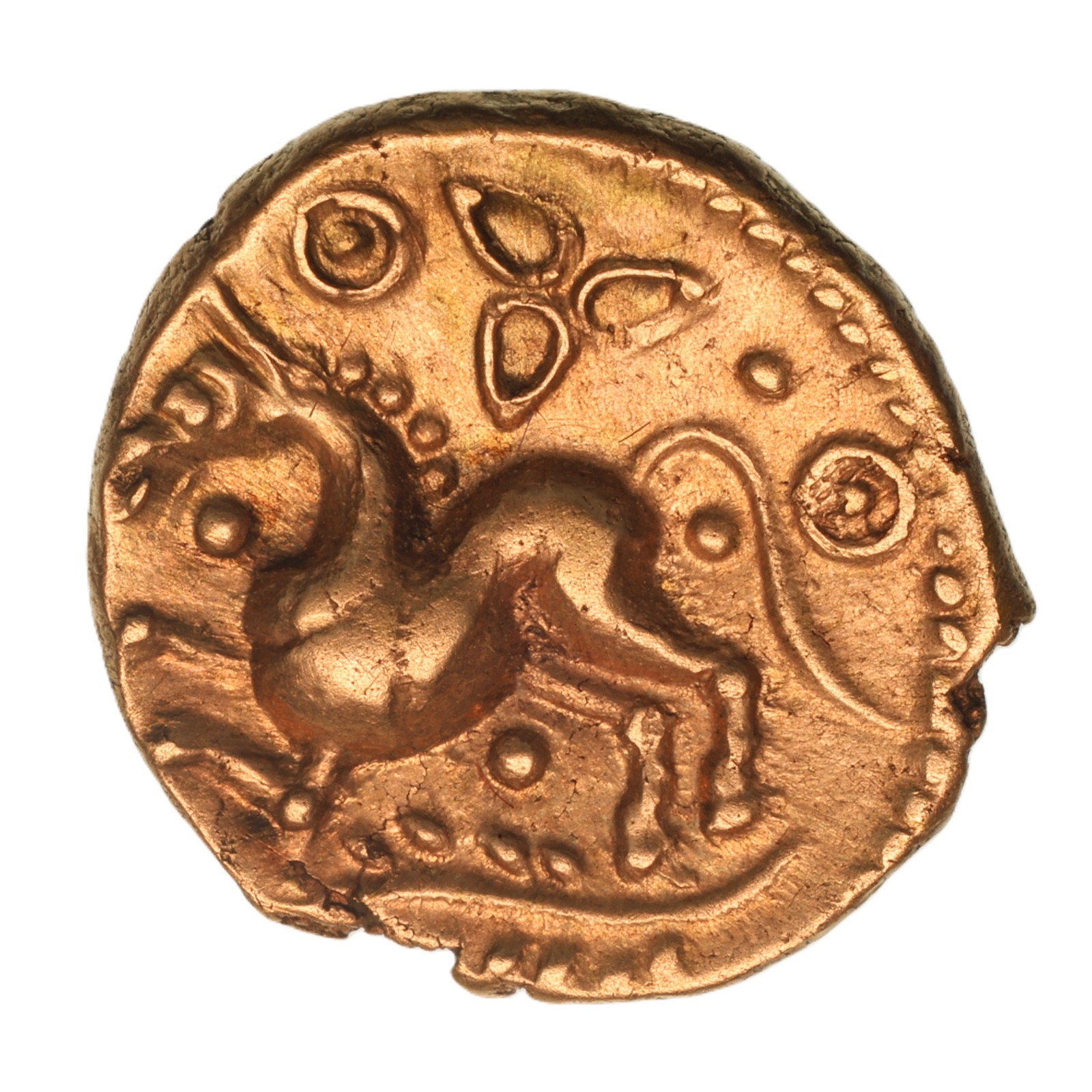
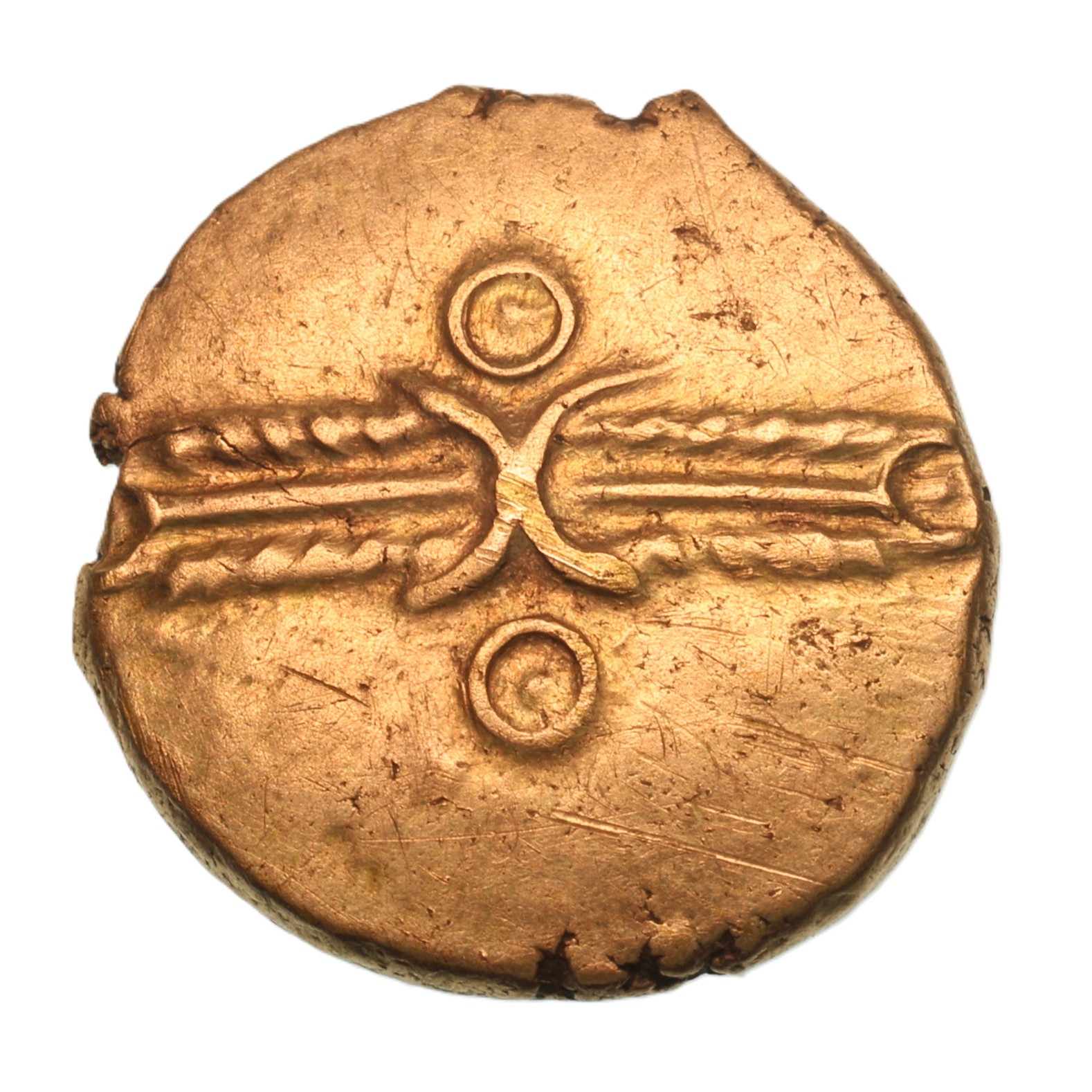
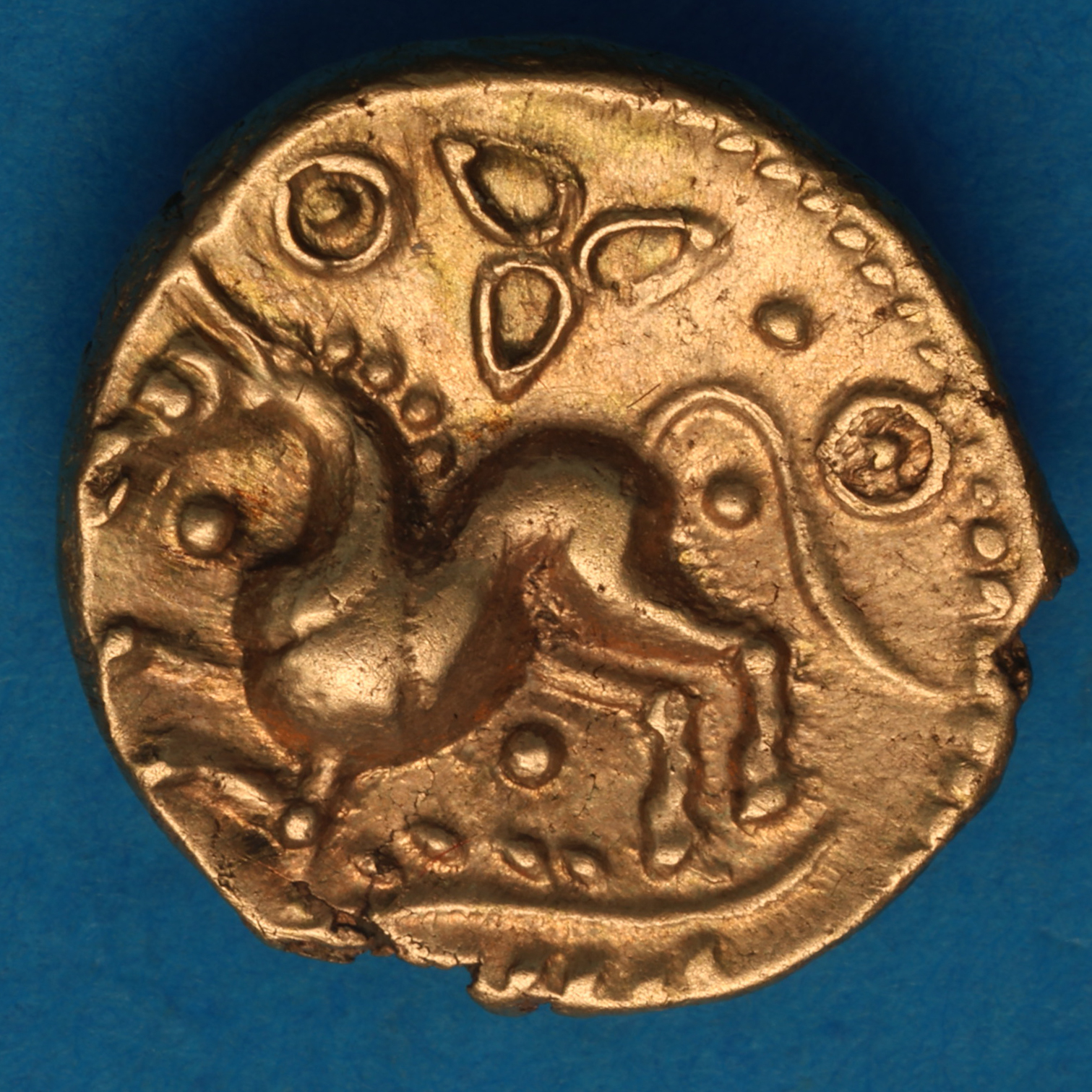
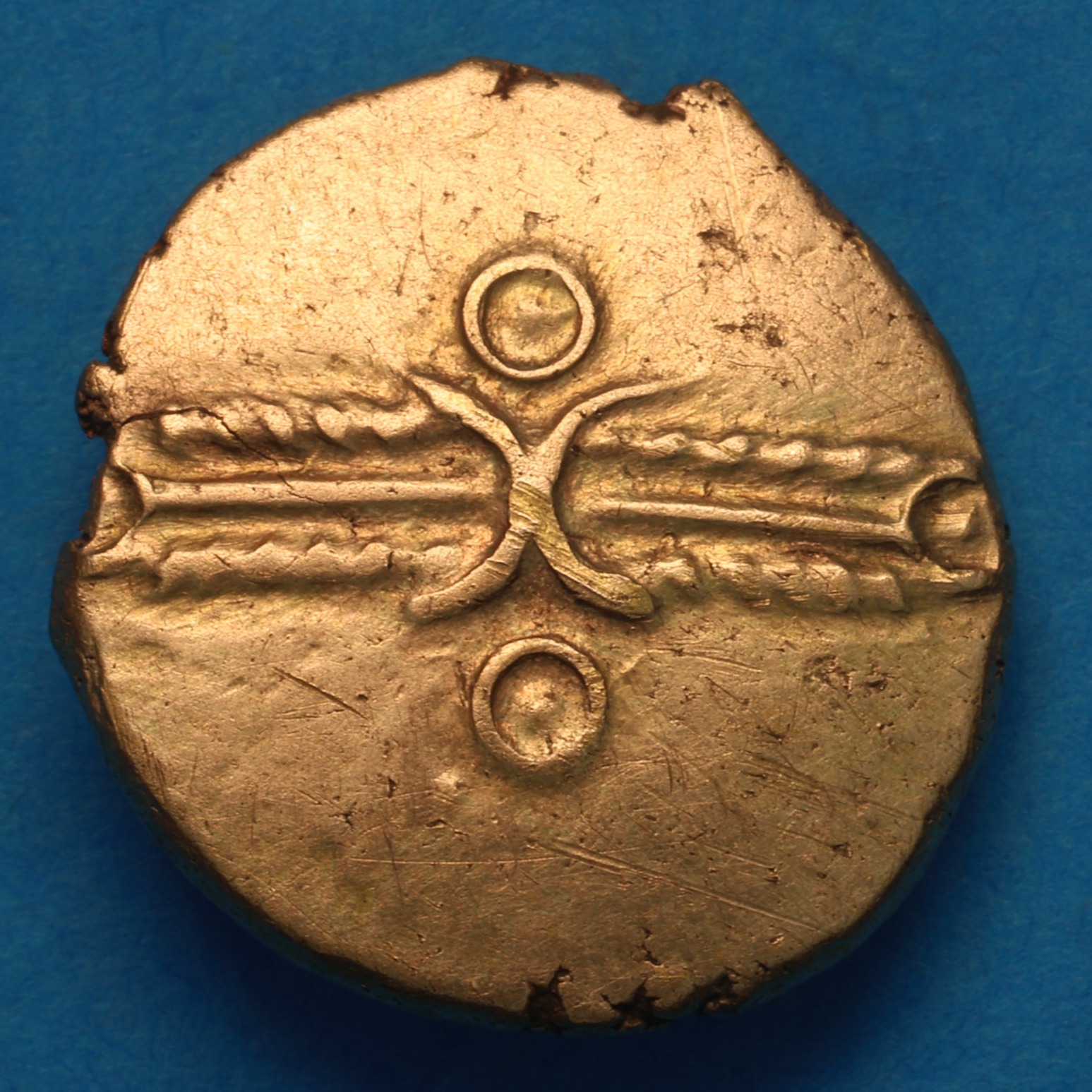
Trinovantes Dubnovellaunos c. 5 BC-AD 10 Trefoil Gold Quarter Stater *Very Rare*
£1,650.00
Trinovantes Dubnovellaunos c. 5 BC-AD 10 Trefoil Gold Quarter Stater
Back-to-back single line arcs in the centre of wreath with a thin line between two lines of leaves with inside ends pointing towards the arcs. Ringed pellet either side of arcs.
Naturalistic horse left with rear legs splayed out behind. Arched, leafy branch below. Trefoil (teardrop triad) above. Pellets above, below, in front, below head and under tail.
Very Rare
ABC 2395; 12mm, 1.36g
Van Arsdell Classification: Trinovantian L, Earlier Dynastic Issues, Dubnovellaunus in Essex, Gold Coins.
Sills DK 545 (3 obverse, 5 reverse dies): North Thames Coinage; Type: Dubnovellaunos; Quarter Staters: Class 2b – Two or No Rings.
Sills chronology: Gallo-Belgic Ca – British G (Early Clacton) / Aa Westerham – British La (Whaddon Chase) – British Lb (Westbury) – Addedomaros – Dubnovellaunos – Tasciovanos.
Dubnovellaunos was almost beyond doubt king of both the Trinovantes and Cantii. Around 7, at the end of his reign, he and Tincomarus of the Atrebates appeared in the res gestae as supplicants to Augustus, but it is not known whether that was king of the Trnovantes or Cantii at the time.
Provenance
This coin is from The London Collection of Ancient British Coins. For more information click here: The London Collection – Silbury Coins : Silbury Coins
Tony Carter Collection Sept 2008 VA 1660
This coin comes with a previous label.
Dubnovellaunos (c. 10/5 BC–AD 10?)
Dubnovellaunos is an intriguing character within the Late Iron Age coin series, not least because (if the same person) his issues appear to have been struck and/or used in both Kent and Essex. However, his Kentish issues show much more variety, suggesting that he may well have begun his rule within the territory of the Cantiaci. Striking in gold, silver and bronze, it seems to be that he likely overlapped at least partially with the reign of Tasciovanos. One piece of evidence for this is provided by a small hoard from Toppesfield, Essex, which contained two staters of Tasciovanos alongside three staters and a quarter-stater of Dubnovellaunos. He may well be the ‘Dumnobellaunos’ referenced in Augustus’ Res Gestae, perhaps implying his acquiescence to Rome during the early 1st century AD.
Out of stock
You may also be interested in these…
Related products
-
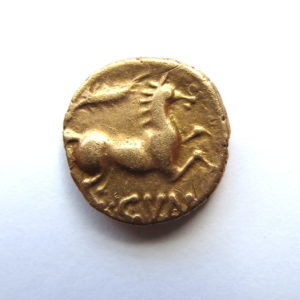
Catuvellauni & Trinovantes Cunobelin Plastic Type Gold Quarter Stater 8-41AD
£425.00Code: JC517
-
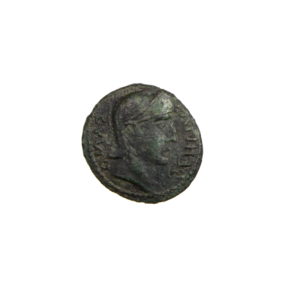
Catuvellauni & Trinovantes Cunobelin Bronze Unit 8-41AD High Grade
£265.00Code: AC397
-
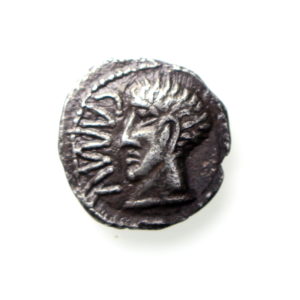
Catuvellauni & Trinovantes Cunobelin Silver Unit 8-41AD
£450.00Code: AC741
-
Catuvellauni & Trinovantes Cunobelin Gold Quarter Stater Classic Type 8-41AD
£395.00Code: AC295