The Tarrant Gunville Hoard

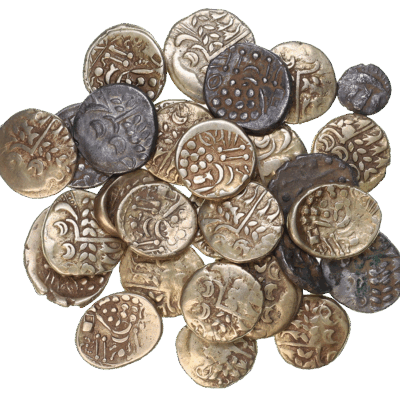
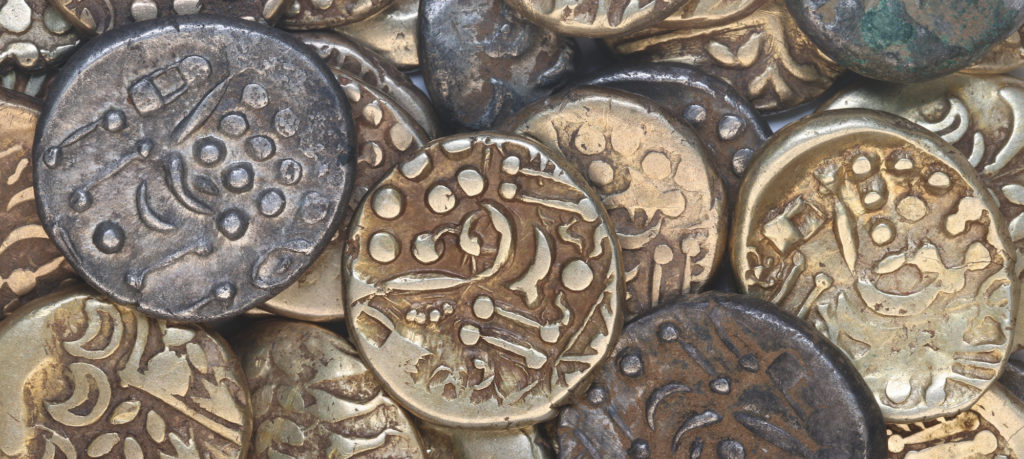
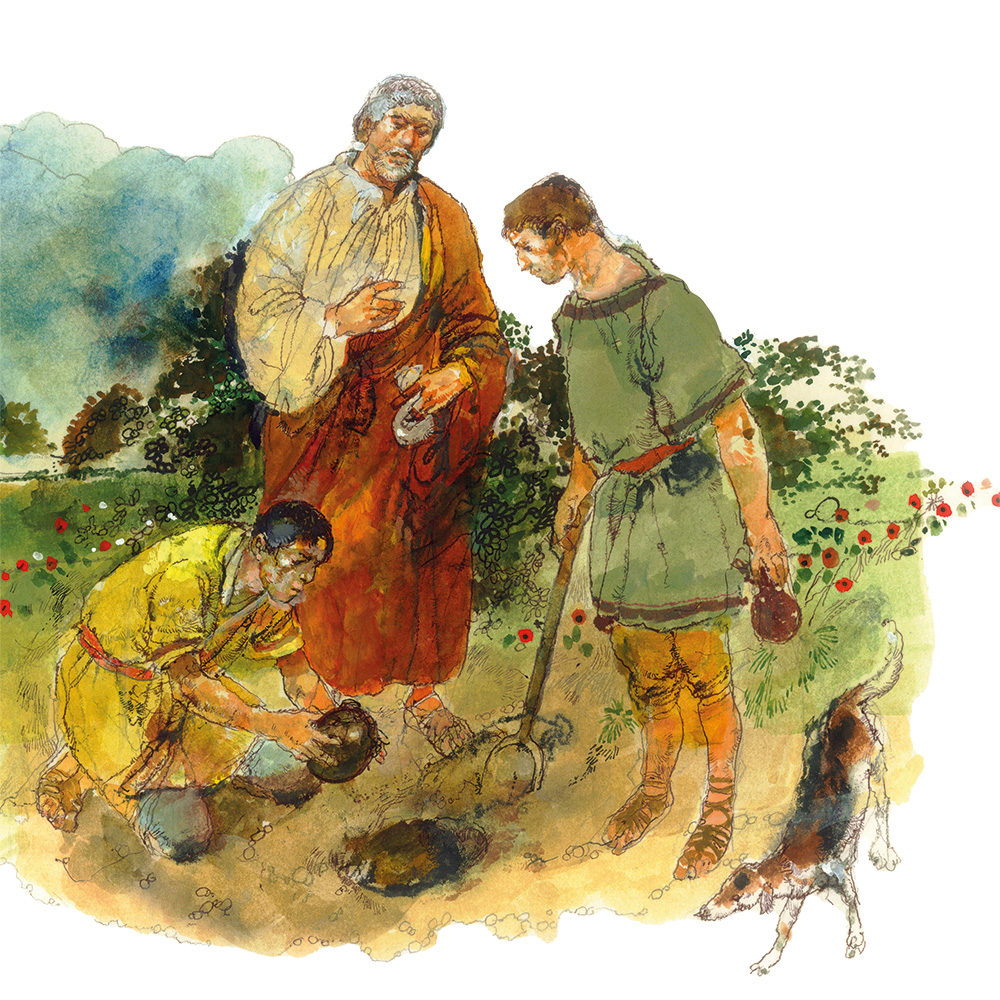
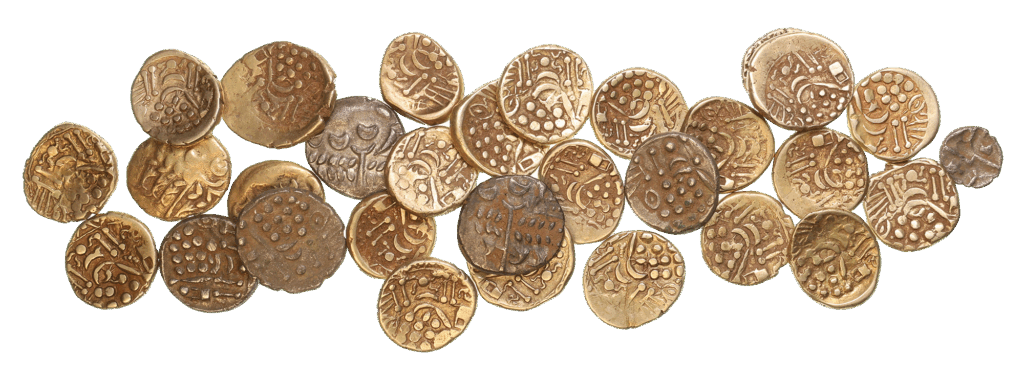
In July of 2022, a metal-detectorist in the east Dorset parish of Tarrant Gunville recovered an important hoard of Iron Age coins. Numbering 31 pieces in total, the hoard (see PAS DOR-00A195, 2022T973) was found in two batches on cultivated land. The initial group of 24 coins was duly reported to the Coroner and Finds Liaison Officer following their discovery, before being handed in to formally progress through the Treasure process. The following year (2023), after the site had been ploughed, a further group of 7 coins were found. With no interest to acquire the hoard forthcoming from either local or national museums, it was subsequently disclaimed and returned to the finder. Having elected to sell the entire hoard en bloc to Silbury, it is now offered here to both collectors and appreciators of the Iron Age series alike.
 

View coins for sale

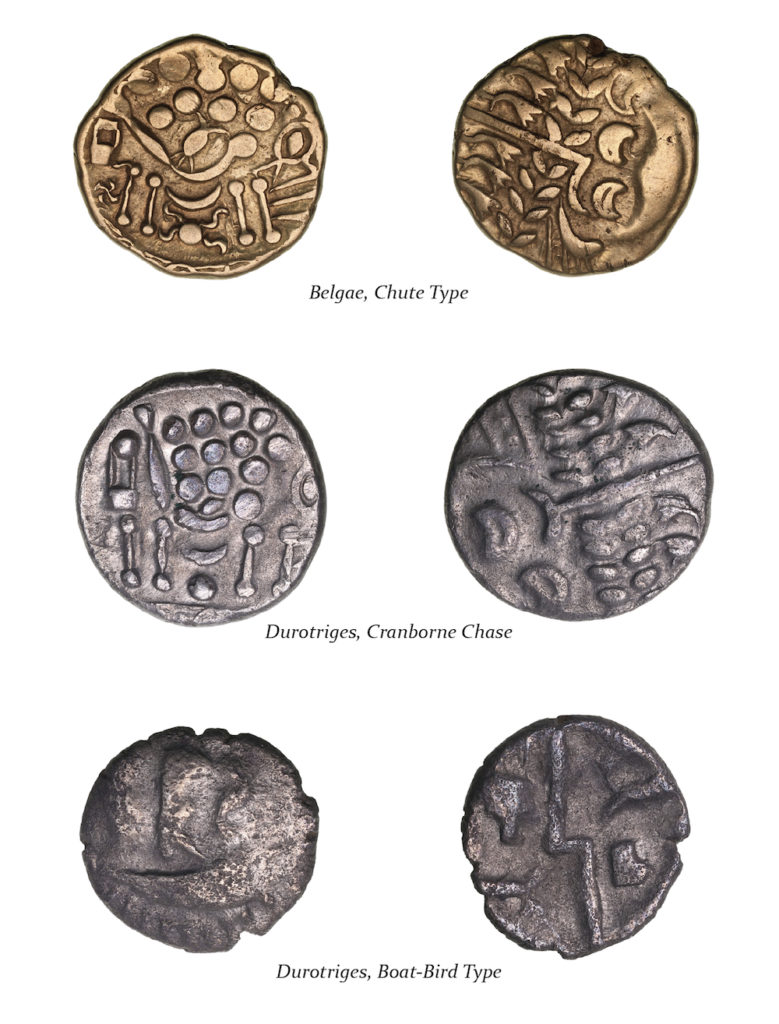
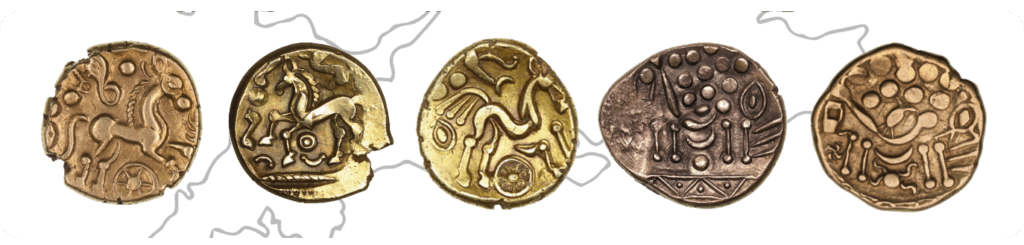
The hoard comprises 24 gold staters, 6 silver staters and 1 silver quarter-stater. All the gold staters are of the so-called ‘Chute’ type issued in southern England (ABC 746, BMC 35-76), while the silver staters are Durotrigan ‘Cranborne Chase’ issues (ABC 2157/2169) and the singular quarter stater an example of the Durotrigan ‘Duro Boat-Bird’ type (ABC 2208, BMC 2734-2747). When precisely it was buried is hard to determine, though on the basis of its content perhaps more likely than not somewhere in the period c. 50-40 BC. The hoard was discovered in the topsoil following its disturbance by agriculture, and as such nothing can be said about how it was placed in the ground or indeed what sort of archaeological context it was originally associated with.

Interestingly, this Iron Age coin hoard is not the only one recovered from the parish. A group of 9 Durotrigan Cranborne Chase staters was also recovered relatively close by in 2023 (PAS DOR-2D6235, 2023T653). However, this was probably deposited a few decades later given the presence of highly debased coins from late in the type sequence. Another Iron Age coin find from the parish was also recorded by the famous archaeologist Sir John Evans, he of Knossos fame, who noted the discovery of a Chute-type stater at Tarrant Gunville in his 1864 work ‘Coins of the Ancient Britons’. That such finds should be relatively prevalent in this area is unsurprising, given that the parish has produced strong evidence for occupation throughout the Iron Age. Additionally, it is located just a few kilometres east of the major hillfort at Hod Hill.

MAPPING THE GOLD BELT

In the middle of the 1st century BC, during a period lasting between the middle of Caesar’s Gallic War and the early 40s BC, a diverse group of indigenously produced uninscribed gold coinages sprang up in Britain. From a geographical perspective, these were produced within what the Iron Age numismatist John Sills referred to as a ‘gold belt’, running across a broad swathe of southern England. While diverse in their iconography, all are highly comparable in the sense that they appear to have sprung up contemporaneously and were produced extensively.

These widespread coinages include a number of iconic, well-known stater types which will undoubtedly be familiar to the Iron Age specialist. Struck at a weight standard of approximately 6g, they include the Whaddon Chase; Climping; Westerham and Selsey uniface groups. However, at the western extremity of the ‘gold belt’ we find another coin grouping – the so called ‘British B’ types of south western Britain’s eastern border. This includes the prolific Chute staters, as well as a smaller number of rarer types found much less frequently. It is these coins with which we concern ourselves here.

EVOLUTION OF THE CHUTE TYPE STATER

Chute-type staters are just one of the various south western British types that are essentially based on a model provided by the Westerham issues (British A, recently renamed the Lepe type) – or at the very least something closely related to them. Interestingly, while in regions further to the east coin designs change overwhelmingly towards the end of the 1st century BC and into the 1st century AD, coins issued in south western Britain are much more conservative in their iconography. Though continuing relatively unchanged in overall design for nearly a century, they became steadily more and more debased from both artistic and metallurgical perspectives as time went on. This stands in stark contrast to coins issued within the south eastern and North Thames regions, where designs evolved more rapidly during the later 1st century BC and subsequently moved towards overtly classical imagery during the early first century AD.

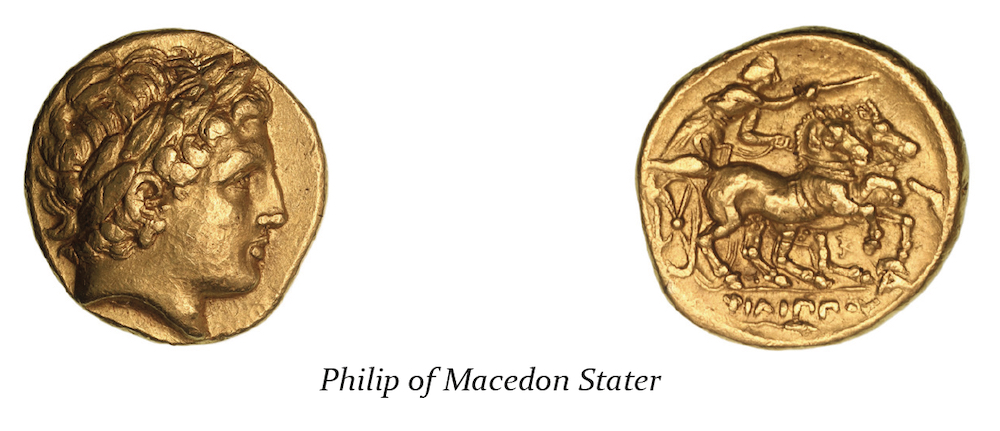
The Westerham type and its derivatives, including the Chute, are perhaps some of the most abstract of all Iron Age coins. Their obverse and reverse designs are essentially the product of repeated down-the-line copying from an original prototype of completely different cultural affiliation, which originated thousands of miles away from Britain. This was the gold stater or ‘Philippus’ struck for Philip II of Macedon (r. 359-336 BC), father of Alexander the Great. While on first sight this might seem an implausible link to make, it perhaps makes more sense when we consider that both Philip II and Alexander likely utilised ‘Celtic’ mercenaries from what is today eastern Europe in their armies. Such warriors would have required paying for their service, and evidence from both stray finds and hoards shows an influx of gold staters and silver tetradrachms making their way northwards from Macedon into Europe proper. In and around the River Danube they both actively circulated and were intensively copied by local peoples who decided to issue their own coins. Becoming steadily more degraded as it moved westwards, the classical artistry of Apollo’s profile portrait and Nike galloping right in a two-horse chariot (biga) made its way through central Europe and Gaul before eventually arriving in Britain – located at the north western tip of the ‘Celtic’ world.’

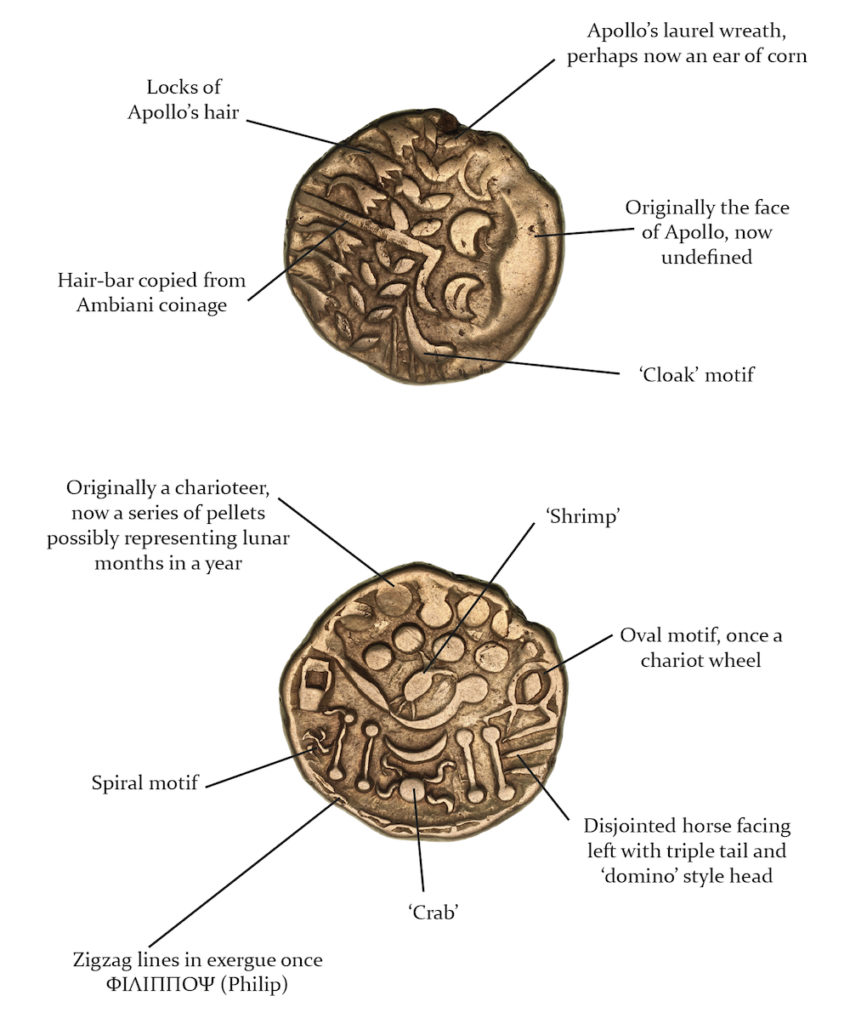
In their final British iteration, these motifs become extremely abstract. The bust of Apollo takes on a highly stylised appearance, incorporating a wreath motif with upward-pointing leaves, a central horizontal line and several crescent motifs to represent the face.

Similarly, the horse and chariot is reduced to a clustered group of pellets, crescents and dots. Key to identifying the Chute type is a characteristic motif also depicted on the reverse, located between the highly stylised horse’s legs. This takes the appearance of a central pellet with four curvy legs, described by some as depicting a crab or similar animal. While the presence of this motif enables attribution of a coin to the Chute type, it is its specific appearance which permits for further classification down to the sub-type level. For example, as per John Sills’ typology, type 1a has ‘legs’ which are plain, while on type 1b the legs all have pellet terminals.

coin pile

AFFILIATION

With all this in mind, we must now consider the question of whom exactly produced the Chute staters. Frustratingly, the answer remains unclear. A number of scholars have assigned them to the Durotriges, based on the fact that they are stylistically extremely similar to, though clearly separate from, the widespread ‘Cranborne Chase’ type staters of silver. These are definitively of Durotrigan origin and occur widely within Dorset, though appear to emerge slightly after the uninscribed gold coinages and continue well into the 1st century AD. Though beginning in decent silver, they became heavily debased – the final coins in the series being reduced to highly crude cast bronzes.

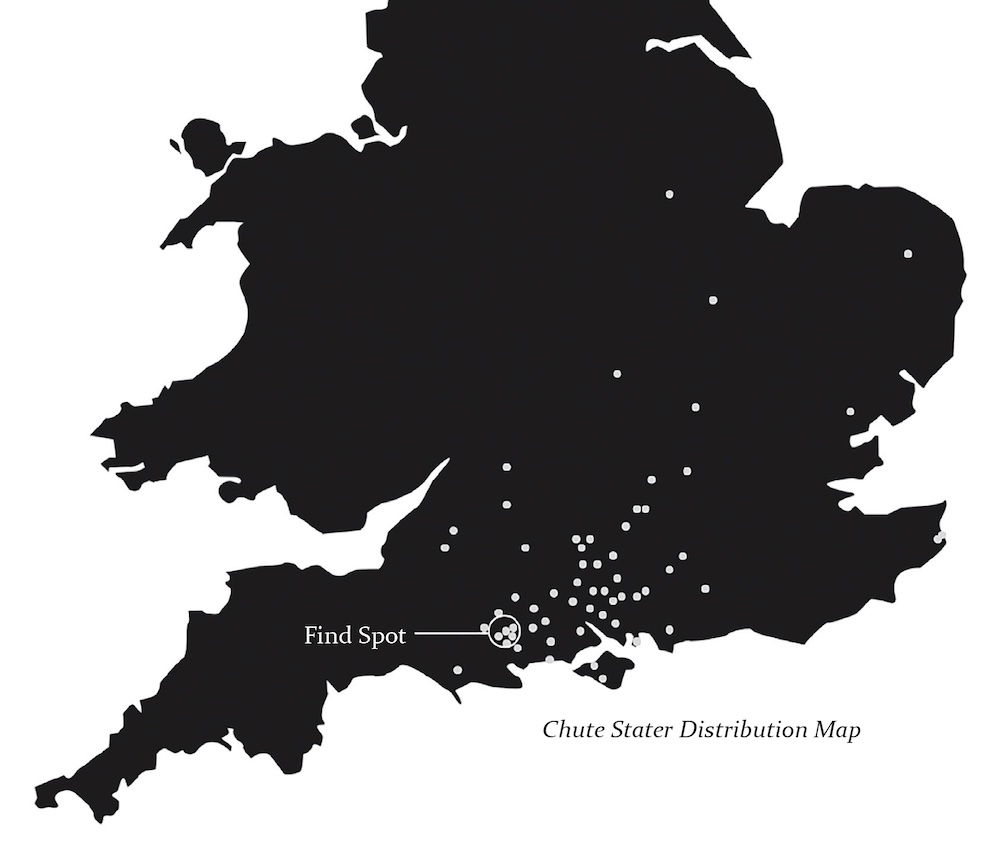
However, in his 2007 article on the subject, Philip de Jersey questioned whether the Chute type should be grouped in with the latter – pointing out that at the time he was writing no finds of Chute staters were known west of the Stour (i.e. in central Dorset, the Durotrigan heartland). Instead, the overwhelming majority occurred in Hampshire or southeast Wiltshire, with a few further, scattered finds in West Sussex. He furthermore noted that while from a design perspective the Chute and Cranborne Chase staters are similar, those in silver copy the Westerham type much more closely – though they have a vastly different metallurgy. As such, rather than giving the coinage to one specific tribal grouping, de Jersey suggested that production of the Chutes took place on a much more localised basis – perhaps being issued under the auspices of ‘a single powerful individual with control over some part of this region’.

This is a point further expanded upon by John Sills within his magisterial work on Iron Age gold coinage, Divided Kingdoms (2017). Even following the recording of hundreds more coins, their distributive focus is still centred too far eastwards to enable attribution to the Durotriges, continuing the previously observed Hampshire/east Dorset/southeast Wiltshire trend as initially observed by de Jersey. Interestingly, they also appear to have an inland pattern of deposition, with only a few sparse finds occurring within the coastal zone. He suggests that it may be more appropriate to assign the type to an as yet unnamed group occupying southern England, located between the Durotriges to the west and a melting pot of Belgic groups to the east, freshly come to Britain in the later stages of Caesar’s Gallic War.

Find spots notwithstanding, if it is indeed the case that Chute staters are not Durotrigan, this leaves them lacking any significant output of gold coinage – a trait unique among the coin-issuing polities of Iron Age Britain.

WHY WAS IT PRODUCED?

While their cultural affiliation remains uncertain, we can say a bit more about the technicalities of output and production. According to John Sills, the Chute series ‘has the highest survival rate of any major insular series due to many large hoards’, and with a relatively unbroken die-chain based upon 83 reverse dies against 10 obverse it seems to also represent one of the most complete Late Iron Age coin die-chains known to exist. It is this feature which is especially informative on their output, suggesting production was centralised and of high intensity – possibly occurring in one or two brief ‘bursts’ of activity. The latter is also supported by their highly consistent metallurgy and metrology, suggesting they were struck to an exacting standard of both fineness and weight from perhaps a single, large batch of alloy. Analysis of their composition has produced results for a small number of coins, all having a gold content of approximately 36-38% and 45-48% silver, the remainder being copper.

The issuing of the Chute type stater was a relatively sudden occurrence, emerging quickly in a region where neither gold nor coinage generally was prevalent. This emergence, combined with the evidence set out above for its highly intense production over a short space of time, suggests it was produced for a specific purpose. But what exactly was that purpose? While we can only speculate, it is compelling that around the time the Chute staters were being issued (and indeed, other uninscribed coinages of the ‘gold belt’), Julius Caesar had undertaken his two invasions of Britain and was regrouping in Gaul. With him was a quantity of war-booty and many hostages taken from the British tribes to ensure their good behaviour, with agreement that an annual tribute (effectively a ransom) would be paid to Rome. The enactment of this is in late 54 BC is recorded by Caesar himself in book 5, chapter 22 of De Bello Gallico, as well as well as by contemporary historians and some letters of the statesman Cicero. Though it has been suggested that the tribute was only agreed upon in principle and never actually paid, in the reign of Augustus the historian Strabo mentions that it had ceased to occur.

Although it had apparently lapsed at some juncture (perhaps in the aftermath of Caesar’s departure for Italy and subsequent commencement of the Civil War), a system of trade tariffs seems to have emerged in its place. Both its composition and how the British tribes actually co-ordinated its collection are both uncertain, though it was most likely paid (at least partially) in the form of coined bullion, perhaps being collected together at some kind of central location before its transfer to Roman control.

HOARDS CONTAINING CHUTE STATERS

The Chute type, while known from many single finds, also occurs within numerous hoards – a feature which assists greatly in establishing their chronology. Many of the well-known Chute hoards are solely comprised of this type, such as those discovered at Ringwood, Bowerchalke and Tarrant Launceston. However, they also occur with other coins – as clearly demonstrated by both our hoard from Tarrant Gunville and several other notable finds. A deposit found at Shorwell on the Isle of Wight (see PAS IARCH-DF1EE5 for summary) contained 156 coins, of which 18 were Chute staters and 138 Cranborne Chase issues of the Durotriges. A similar co-occurrence can be seen in the Tisbury, Wiltshire hoard (227 coins, 8 Chute and 219 Durotrigan Cranborne Chase staters – PAS WILT- 057637, 2010T646/WILT-7BB3D6, 2011T105/WILT-C39DC8, 2012T505), recovered in three batches between 2010 and 2014. Other hoards show the admixture of Chute staters with other types of Iron Age coins.

The two adjacent hoards from Whitchurch, Hampshire, are thus far unique in that they contained a mix of Gallo-Belgic E (gallic war uniface) and Chute type staters. Additionally, there is a very small input into the Whaddon Chase find from Buckinghamshire, though greatly outnumbered by the very large quantities of British L and Q type staters. Incredibly, Chute staters are also present (although as with the Whaddon Chase hoard, comprising only a very few pieces) within the enormous Le Câtillon II (Jersey) find of over 70,000 coins, discovered by metal-detectorists in 2012 and subsequently block-lifted for excavation in a conservation lab. These more far-flung finds of Chute staters, located well outside their usual distributive zone, must surely have moved via regional networks of contact, trade and exchange.

WHY WERE THE HOARDS BURIED?

The way that coins and money functioned in the Late Iron Age of Britain was fundamentally different by comparison with the modern world. All the currently available evidence suggests that in general(especially in the southwest, which was not universally monetised), coinage did not circulate as currency. Only at the very end of the Iron Age, in a few restricted areas (such as the North Thames region), did anything remotely resembling what we might recognise as a monetised economy develop. In the timeframe we are discussing here, what we interpret as ‘money’ from a modern perspective played very different roles.

Early gold coinage in Late Iron Age Britain may have functioned at least partially in votive contexts. That is, being deliberately buried in the grounds for social or religious reasons. This would certainly explain why the overwhelming majority of coins discovered have relatively little wear from circulation.

Find spots show that this deposition took place on a widespread scale in the form of singular pieces, small groups and larger hoards, generally being buried well away from areas showing evidence of formal settlement. Although religious reasons may form part of the explanation as to why these pieces were buried, they are by no means the only one. Coins could have equally been employed as agents in contact and communication between different groups or peoples, perhaps being deposited in the context of political ceremonies or meetings. Alternatively, they could have been placed as part of marking important events in a symbolic fashion, such as the formation of alliances or declarations of war.

With some notable exceptions, gold has for millennia generally been prized over other metals due to its physical properties. It has an attractive colour, can be worked in a number of different ways, does not tarnish or corrode and has a solid weight. Perhaps most importantly, it can easily be melted down to make other things. For Iron Age Britons of high status, gold was likely important both for social display and as a store of wealth, with those at the top of the hierarchy perhaps using coinage in the context of maintaining their power. We can imagine that gold coinage, which in the context of the early uninscribed series effectively comprises high-quality stamped bullion marked with identifying symbols denoting who issued it, could be distributed to individuals or groups. This activity could thus create important social links, as well as maintaining networks of dependencies and obligations. As the academic John Creighton neatly summarises, gold coinage formed ‘portable and transferable symbols of authority’ in Iron Age Britain.

Whatever reasons lie behind the burial of both Chute and Chute-containing (i.e. multi-type) hoards, one final thought worthy of mention is that the majority appear to have been buried towards the end of the overall die-chain. This observation is heavily suggestive that their burial occurred at around the same time, perhaps resulting from an overarching event or change in the political status quo. It is interesting to consider that while the Chute type was struck in large numbers, the related Curdridge and Cheriton types (British Da/b) were much smaller issues. It is plausible that this imbalance reflects the possible nature of the ‘event’ which caused so much material to be placed into the ground – perhaps conflict or loss of territory. In this light, we might plausibly suggest that at least some hoards were buried to prevent capture, or that hoards buried as stores of wealth could not be recovered by their owners due to death or displacement.

CONCLUSION & THANKS

The Tarrant Gunville hoard represents a valuable addition to the corpus of Late Iron Age numismatic evidence from southern Britain. Its composition— predominantly Chute type gold staters with accompanying Durotrigan silver issues—reinforces the picture of an active and interconnected region during the middle decades of the first century BC

Silbury Coins wish to record their gratitude to the finder of the hoard for its prompt reporting, and to the Dorset Finds Liaison Officer and the Portable Antiquities Scheme for their careful documentation and publication of the discovery. Appreciation is also extended to those responsible for such detailed research into the Iron Age coinages of southern Britain, which has provided the essential framework for much of the discussion presented here. Lastly, and perhaps most importantly, thank you to our team who have skilfully produced this booklet.

Enquire about this coin


    I consent to Silbury Coins collecting my details, inline with the privacy policy.

    Sell a coin


      Please use the option below to upload a photo of the coin or item.

      Image one:

      Image two:

      Image three:

      Image Four:

      I consent to Silbury Coins collecting my details, inline with the privacy policy.